continued from developer notes #3
Superiors and Subordinates
Once it was decided to model a Chain of Command there was a need to fill the hierarchy with people. For the Soviet side they were all subordinates but the German side involved an equal mix of superiors as well.
Subordinates are easy to deal with. You give them orders and they carry them out. Perhaps not quite how you’d like them to and perhaps with a degree of resistance but, overall, if you ask them, they’ll do it.
Superiors immediately run into the problem of authority. They are your boss. You’ve got one at work and you’ve probably got one at home. Do you want another, game based, one telling you what to do?
Having an upset subordinate yelling at you might not be ideal but having the computer speakers spout forth curt, arrogant, orders from above, demanding that you do this or that, is only going to have you grumpily checking the prices of a new monitor the following day and having to explain why you’ve got a bandaged hand.
A key design challenge that had to be overcome was how to give a sense of being within a hierarchy while at the same time not hobbling the Player’s ability to play the game as he’d like. This is, as you’d imagine, a pretty fine line. Go too far in the direction of authority and the Player ends up chaffing against unwanted restrictions. Swing back the other way and you’ve lost the immersion of having to answer to Superiors.
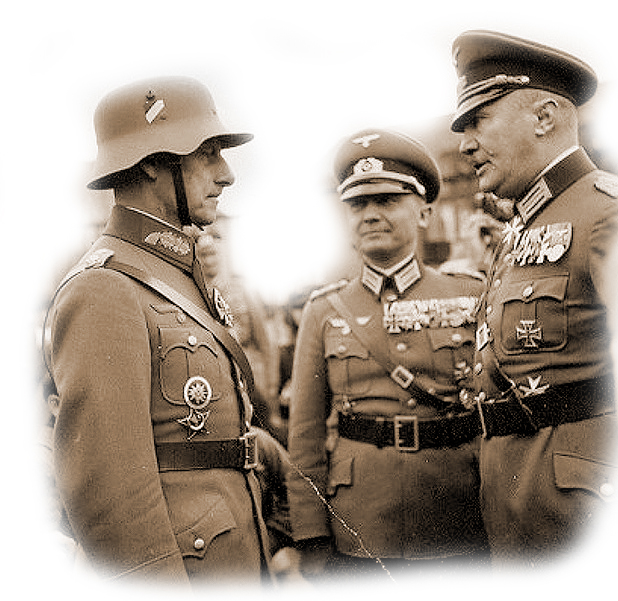
The German High Command structure helped in this. Rather than the highly efficient, well oiled machine that it is typically portrayed as it was, in reality, a dysfunctional organisation with many quirks. There were reasons for this and it deserves a detailed explanation of it’s own but, for the moment, we can assume that the lines of authority were, in many cases, fuzzy.
Von Paulus (on phone) about his conversation with Jodl on the command set-up in North Africa. All the Führer cares about is that Rommel should not be hampered by any superior Hq. Put over him. Jodl will send up another plan.
F.M Von Halder’s War Diary, 13th May 1941
There were many cases of overlapping authorities and individual power bases. Who reported to who was clear cut only where everybody involved was a professional military officer. Higher up, where there were Party members and assorted flunkies, it was a lot vaguer.
It was greatly complicated by the micromanagement and interference of Hitler himself, the man sitting at the top of the Chain of Command. He hadn’t read the book on ‘How to Delegate, sit back and let your Generals Win the War’. Then again, perhaps he had and it had ended up in the rubbish bin. Hitler’s interference was a doubled edged sword. There were times when his intuitive grasp of a situation was far superior to any of the professional military judgements on offer. As the campaign progressed he became more and more convinced that he knew better. Hubris be thy name.
Eventually the great gambler succumbed to the inevitable ‘reversion to the mean’ that applies to all mortals. Sheer force of personality and a domineering, dictatorial, manner couldn’t overcome the law of averages. Like any compulsive gambler he ended up losing more than he started with.
Which is a topic well outside the scope of this book. But in terms of superiors it offers some interesting angles. The Player has the role of Operational Commander of the Eastern front – F.M Franz Halder. He had a direct superior officer, that of F.M Von Brauchitsch who was Commander in Chief of the German Army. Both are professional military men and it was a clear cut relationship.
Except it wasn’t. F.M Von Brauchitsch was considered ineffectual in dealing with Hitler. Here is a superior who, on occasion, would step forward and do his job but who, most of the time, was too busy dealing with his own problems. Hitler was his personal banker. Von Brauchitsch was in heavy debt to the Fuhrer. He lacked the moral fibre to stand up to Hitler when it was necessary. By the end of 1941 he was gone. A convenient scapegoat for the failure to take Moscow and in failing health. Exit stage right.
Then there were the motley cast of Party characters who were all higher up the Chain of Command but whose influence over the Player’s assigned role varied and was, at times, murky. They were superiors but off to one side, tangential to the main game. But all of them were capable of exerting an influence when the need arose. We could consider them to be part time Superiors.
The German Command structure was unique in that authority over logistical matters was split between two people – General’s Gercke and Wagner. Logistical concerns are always going to play an important part of an invasion of a country as geographically vast as Russia. Gercke and Wagner are destined to have staring roles in a game portraying Operation Barbarossa.
Which raises the question of whether they were superiors or subordinates? They were neither. Both were in the category best defined as ‘unclear’. Both straddled multiple roles in dual headquarters (OKH & OKW).
This is a gift. Here are two characters dealing with the one key function. It’s a little like having two separate builders work simultaneously on an extension for your house. They both have their own teams of subcontractors. They are both jointly building your extension. Yet when there is a problem who do you talk to? Is one going to blame the other? Are you going to have to take sides? How are you going to keep them both happy and maintain the momentum?
What about inter service rivalries? Naval matters were largely constrained to the bathtub. They did play a part but it was the kind of role that you’d hire somebody off the street for. They’d be instructed to say a few lines, smile at the camera and don’t cause any trouble.

For the Luftwaffe, however, you’d need a competent actor, one with enough gravitas to carry the part. It’s a major role. The Air war was an important aspect of the campaign. Hermann Goering, the corpulent, overdressed Reichsmarschall, competently holds down this role with his own unique style. He is both a superior in the chain of command and a character with whom the player will have a lot of contact with. He was colourful, unpleasant, eccentric and a take-no-prisoners political infighter. Perfect.
Cheers,
Cameron