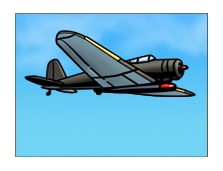
 Welcome back to Advanced Tactics Gold college! Its going to be an important lesson today. So far we have only been looking into ground troop types. Today we will discuss the air theater. There are three good reasons to create an airforce. First of all: Creating an airforce will give you the same sort of power as artillery, but with extreme range and mobility. Secondly: possession of an airforce will allow you to use a number of special orders like para dropping and air recon. And thirdly: an airforce is the best form of air defense if your fighting an enemy with its own airforce.
The most important aircraft types are the fighter, the dive bomber and the level bomber. Our main focus in this lesson will be on them. At the end of the lesson I will also briefly discuss the more specialized types: the transporter, the strategic bomber, the carrier fighter,the torpedo bomber and the kamikaze fighter.
In a non-stone age game the fighter, dive bomber, level bomber and transporter will be available for production immediately, the other aircraft types require research before being available for production.
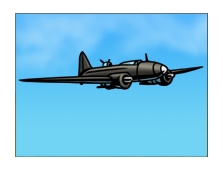 Lets start with looking at level bombers. Level bombers cost only 1250 production points to produce, compared to 2000 production points or more for most other aircraft types. The level bombers is the aircraft type that is most efficient against infantry. Using 5 level bombers versus 100 infantry with entrenchment level 125 will still cause 6 deads and 10% readiness drop. For comparison: 5 divebombers would kill only 4 infantry and 5 fighters only 2 infantry. Level bombers also have some capability to do structural dammage and can be used to bomb towns or bridges. However i advise using strategic bombers for that purpose instead.
 Those level bomber combat results might not be a very convincing argument for building an airforce. But keep in mind that infantry the troop type that is most resilient when faced with air attack. If we look at the dive bomber we will start to see some real power. for example: 5 dive bombers attacking 5 light tanks or 5 anti-tank guns will kill half of them and cause over 50% readiness to the remainder.
Keep in mind it is the big equipment like artillery and tanks that are really vulnerable to your airforce. The weapon of choice to take out these prime targets is the dive bomber. You can use other aircraft types, but they wont perform as well: when attacking the same target as the dive bombers in the previous example 5 level bombers would maybe just kill 1 light tank on average and 5 fighters would have to be really lucky to kill even that one tank.
Heavier tanks become harder and harder to kill for lighter tanks, but the effect is not linear for aircraft. The heavier the tank becomes the relatively (production point wise) better the odds become for dive bombers to take them out.
The dive bomber can have tremendous impact in stopping an enemy blitzkrieg style offensive. Because at some moment the enemy panzers will have advanced beyond their air umbrella, at that point you should strike the enemy spearheads with your dive bomber squadrons and blunt his offensive power.
When attacking ground targets aircraft suffer penalties from -50% to -75% when attacking the enemy in rugged terrain like forests, mountains and urban. The worst ground target an airforce can thus face is infantry in jungle or mountains. (sounds familiar?) Also enemy flak might become a real issue in rugged terrain.
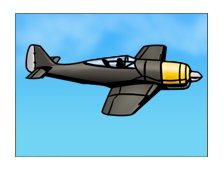 Unless the enemy has no airforce, the fighter should be used to take out enemy aircraft, escort your bombers and not to attack enemy ground units all by it self. If enemy fighters are on intercept you can lure them into combat by attacking a ground unit close to their airfields. Defending fighters always have a small advantage when dog fighting. Best way to take them out is to attack the enemy on its own airfields. If you do so you will get a surprise bonus that will at least negate the natural defensive fighter advantage. Furthermore when attacking the enemy on its own airfields you can bring your level and dive bombers, they will then take out any enemy bombers present on the enemy airfields. The rather cheap level bomber is perfect for this job.
To defend your own troops from enemy air strikes you must make sure fighter units are close enough to the front and instructed to intercept. Your intercept setting can best be put at 75% readiness. This will avoid your fighters going into combat on low readiness and taking big hits. In case you have completely no air superiority you might even choose to set intercept setting to „don’t“ and first build up an airforce of some size before confronting your opponent. Intercept range of your aircraft is half their normal attack range modified with their readiness percentage. Keep in mind that intercept is never assured, at the edge of the intercept range of your aircraft it is only 50% chance for intercept.
If fighting for air superiority try to maximize the attack with up to two times as much fighters as the defender can bring up. Numbers count!
If your enemies are capable of doing a lot of air strikes it is important to build airfields close to the front line to ensure intercept cover, as well as keeping some flak with spearhead formations, that might outrun your air umbrella.
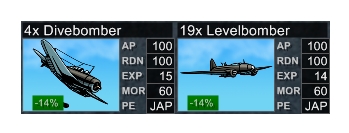 With the release of ATG v2.06 a new airfield stacking rule is also in effect. What this rule basically does is limit the amount of aircraft that can operate from the same air base or city without penalties. Once you overstack an airfield a green colored negative percentage will become visible on top of your aircraft illustrations. This percentage is the penalty these aircraft will suffer when doing battle, either in defending their own air base, intercepting or attacking an enemy hex. Keep in mind fighters are only 5 stack points, while level and dive bombers are 10. Airfields and regular cities can hold 100 air stack points, capitols 200. Since this is a relatively new rule it might very well still be fine tuned in upcoming patches.
Not only is there a penalty if you have to many aircraft on the same runway, also there is a penalty if you attack with to many aircraft on the same hex. This is called air battlestack and works the same as artillery and land battlestack. Basically there are only so many aircraft that can effectively attack the same hex in one round.
In previous lessons it was often emphasized that blitzkrieg style offensives are the way to go. Last lesson advised combining artillery and tanks. This lesson recommends you to also use aircraft. First strike the hex with artillery and air and only then commence your land attack. This combined arms approach will give you great results and will allow you to maximize firepower on a hex like never before.
Another advantage with having an airforce is the option to do air recon and finally check out the situation behind the front line. This way you can see enemy offensives coming! Use fighters in this role since they have the best recon scores.
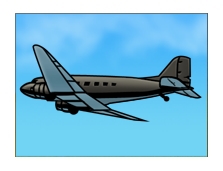 Transporter aircraft can be used for a number of purposes. First of all to paradrop paratroopers. If an enemy has not defended in depth this can be a great strategy to use, and when used in conjunction with a blitzkrieg offensive will make it much easier to ensure the encirclement. Use the paratroopers to capture bridge hexes and vital road junctions or drop them exactly at the point where you expect your panzer pincer movements to meet up. But transporter aircraft can also airlift non-paratrooper units. This is an excellent alternative to strategic transfer. Furthermore transporters can also be used to do air supply drops. This can be the only way for you to keep encircled troops alive!
Then there are torpedo bombers and carrier fighters, both take only half the room on board of an aircraft carrier then regular aircraft. This is a big plus in itself when fighting on the high seas since it allows you to bring double the amount of aircraft with your carriers. Furthermore torpedo bombers will perform much better against naval targets then other aircraft. If however you do not have torpedo bombers use dive bombers against enemy naval units. When attacking enemy naval units keep in mind cruisers have excellent flak and should optimally only be attacked by torpedo bombers. Also keep in mind that submarines are especially vulnerable to airstrike.
The Kamikaze is only available to the Japanese. Since the Kamikaze blows itself up in the first combat round it has a good chance to hit a target before being killed by enemy aircraft or flak. Basically the kamikaze is only interesting if you want to do some damage to enemy surface vessels but no longer have the power to build an airforce that is on par with that of the enemy. Admittedly it is a weapon thats mainly useful in desperate defense or in some sort of shock-doctrine were you really need to take out that enemy naval unit.
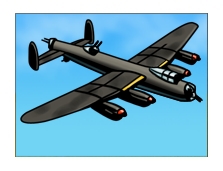 Last but not least there is the strategic bomber. Its slightly expensive, but it does 4 times as much structural damage as the the level bomber and has much better range. If you can bomb and reduce your enemy his towns, mines and oil wells to 0 structural points, he will have no production capacity and you will be able to bring him on his knees without doing any major fighting.
The trick in using air power wisely is to have a balanced air force. Have enough fighters to protect your airspace and if possible attain air superiority… Have some dive bombers to strike at enemy armored spearheads were necessary… Keep some transporter units and paratroopers ready for when an opportunity opens up to take a key bridge behind enemy lines… Keep some strategic bombers ready, just in case you can strike an unprotected enemy oil well. Having a diverse airforce at the ready gives you striking power, operational flexibility and forces the enemy to build its own airforce, keep more garrisons and build flak on key production sites.
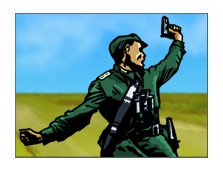 Is a specialized troop type. Staff fights only half as well as regular rifle infantry, but that’s ok since they will not be deployed in the frontline and see little actual fighting. Staff should be deployed in your HQ units. Staff is the only troop type with staff points. Each staff has 10 staff points. This means it can direct the operations of up to 10 power points of regular troops in units subordinate to the HQ the staff is stationed in. The game will show you if you have enough staff in your HQ to direct the battles of all subordinate units by showing a STF % in the unit info window.
 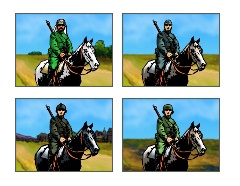 Is an expensive infantry troop type that requires no research to produce. However its levels will go up when you research infantry. Although it has the same number of hit points as rifle infantry it is three times as expensive (in production points) to build. Off-setting this costliness cavalry has three times the offensive value of regular rifle in attacking enemy infantry, artillery or soft-mobile. However that in itself would not make it a valuable troop type since using three rifle instead of one cavalry would still be much more cost-effective, especially in defense.
 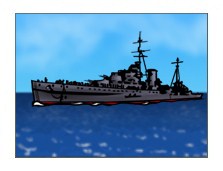 Welcome back to Advanced Tactics Gold college! Today we discuss ships! Let’s start with the basics: Not every map with sea hexes on it requires you to have a navy. A navy is only necessary if you want to invade hostile territory and conduct amphibious operations or if you want to (strategically) transfer troops overseas.
  The first type of ship that we’ll discuss is the Cargo Ship. Its costs 2000 production points and 20 raw to produce. The Cargo Ship is the Train/Truck of the oceans, so to speak… You can place your Cargo Ships in a HQ located in a port city to enable that HQ to (strategically) transfer troops overseas. But you can also put your Cargo Ships in regular units and use them to load/unload land unit troops. The Cargo Ship is the only type of ships that allows loading and unloading of units and thus your only means to conduct amphibious invasions into enemy held territory overseas. The Cargo Ship is very weak in combat and should always be escorted when you expect either enemy ships or enemy airstrikes.
 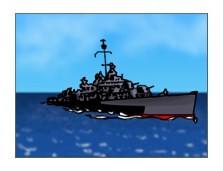 An ideal escort is the Destroyer. The Destroyer is a relatively cheap naval unit and is just 10 raw more expensive then the Cargo Ship. The Destroyer is the lightest ship of war available and will perform well against Cargo Ships, other Destroyers and Submarines. However when facing heavier ships of war the Destroyer will only be temporarily capable of protecting your Cargo Ships.
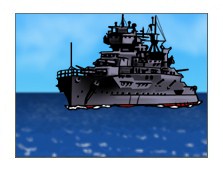 The two capitol ships of war are the Cruiser and the Battleship. They rule the waves but come at heavy cost. Producing a Cruiser takes 4000 production points and 70 raw, a Battleship 8000 production points and 160 raw. However if you are serious in attaining naval superiority these ships are a good investment. They are vulnerable to submarine attack, but you can protect them by assigning a Destroyer escort. The Battleship is on a cost-versus-effectiveness comparison better in ship-to-ship combat and shore bombardment then the Cruiser, but the Cruiser has better anti-air capabilities. A battleship attacking a Destroyer for example has 50% chance to kill the Destroyer but only 5% chance to get killed itself. A Battleship attacking a Cruiser has 50% chance to kill the Cruiser, but only 10% chance to get killed itself.
 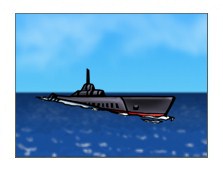 Now the submarine is a bit of a special unit. It has 20 hide points making it harder to spot by enemy forces. Basically it is best used in attacking unescorted Cargo Ships and capitol ships and causing anti-supply damage to enemy supply lanes. Submarines should avoid fighting Destroyers at all cost. For example a Destroyer attacking a Submarine has 30% chance to kill it while it has only 7.5% chance to get killed itself. Also Submarines should avoid coming under air attack at all cost. Submarines are relatively cheap ships with a higher survival rate in combat due to their ability to submerge (turn a kill hit into a retreat hit), but you must remember they are weak units. A submarine is preferably used in an offensive role, since it is very weak when attacked itself. For example: A submarine attacking a Battleship has 12.5% chance to kill it versus a 30% chance to get killed itself, but a Battleship attacking a Submarine has 30% chance to kill the submarine versus only 5% of getting killed itself.
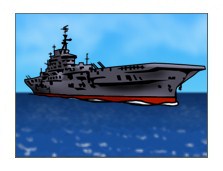 The most complicated and expensive ship to properly use is probably the Carrier. The Carrier is as expensive as the Battleship and though it has some solid anti-air defenses it is vulnerable to almost any form of direct naval attack. The Carrier should be kept out of combat or be heavily escorted. The key to making the Carrier investment pay off is to transfer the maximum amount of aircraft to the Carrier unit that you can. Ideally you’ll have researched carrier fighters and torpedo bombers since they take less space on the Carrier then regular aircraft. For example a Carrier can carry 10 carrier fighters but only 5 normal fighters. Torpedo bombers are in a cost-versus-effectiveness comparison the best unit to destroy enemy ships. A Carrier with full aircraft compliment will be a decisive asset when fighting out major naval engagements in big oceans. For example 5 torpedo bombers have a chance of 50% of killing a Battleship while on average losing only 1 aircraft.
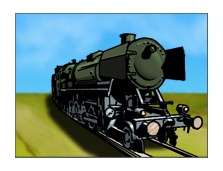 Welcome back to Advanced Tactics college! It has been some time since the last lesson, but I have been away to code on the next DC title in a log cabin in the north of Sweden this summer. So far we have discussed combat troops and equipment, today we will tackle a slightly different subject: troop transportation and motorization by land transport vehicles.
 Though trucks spend oil while they (strategically) transfer troops, they are cheaper to build then trains in terms of raw resources and production time. Trucks are also the more flexible buy, since they can be switched from HQs to units to provide motorization. Granted you can send trains to frontline units as well. But “motorization” by train will limit them to railroad tracks and in most cases it is only practical to do so for artillery and flak units.
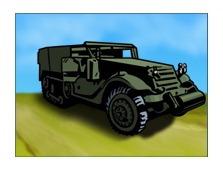 If your motorized troops are going to participate in direct land combat you might want to issue them with halftracks instead of trucks. Yes halftracks are more expensive, and need to be researched first, but they provide a unique feature: they take hits for the infantry in combat. Every time an infantry guy is targeted by the enemy there is a 50-50 chance the enemy will fight a halftrack instead of the targeted infantry.