 And once again: Welcome back to Advanced Tactics Gold college! I am happy to see that you are still with me. Today we are going to take a closer look at artillery. Artillery deserves your full attention since it allows you to damage your opponent without endangering your own troops. Artillery is crucial to attaining victory!
Artillery functions differently from the troop types thus far discussed. It does relatively little direct damage in the form of killing enemy troops. What it does do is decrease the enemy troops their readiness substantially as well as lowering their morale and entrenchment somewhat. For example: 2 artillery attacking 40 unentrenched infantry will only do 3 kills, but they will reduce readiness with a whopping 40 percent.
Keep in mind that readiness is one of the most vital statistics used in combat. For example: 60 of your infantry and 2 armoured cars assaulting 40 enemy infantry with 125 entrenchment will on average lose 14 infantry versus also 14 enemy infantry losses and will have a 60% chance to take the hex. Not bad you might think…
However if we had first used 5 artillery guns on those enemy troops we would have gotten their readiness down to 55 and their entrenchment down to about 60. If we would have attacked after the artillery barrage (with the same troops as in previous example) then on average only 2 infantry would be lost versus 20 enemy infantry lost and a 98% chance on successfully taking the hex would be realized.
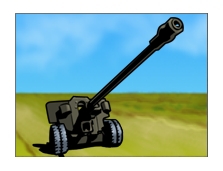
I hope this example has shown you why building artillery is a good idea. Artillery comes in two sizes: artillery and heavy artillery. Regular artillery can attack from 2 hexes away and heavy artillery from 3 hexes away. Heavy artillery however is double the price to construct while it does almost the same amount of damage. The reason to get Heavy artillery is not to increase casualties and readiness reduction, but to increase structural dammage. The heavy artillery does 4 times the amount of structural damage that regular artillery does. Which brings us to sieges.
In previous lessons it was already shown that substantial enemy garrisons will be able to “hedgehog” in or around a town and be able to hold off your attacks. To repeat: Towns allow up to 200 entrenchment score for troops garrisoned in it. This, plus the advantageous landscape modifiers and the fact that most towns will be a source of supply makes it possible for the defenders to hold on indefinitely…
Indefenitely? Well…. Not if the attacker brings some artillery units with him. With artillery you can bombard the town without having to engage in costly battles. Yes artillery barrages will soften up the defender for assault, but the key here is the fact that artillery does structural damage to locations as well. By reducing the defending town to eventually 0 structural points you will destroy the supply source of the defenders. Without supply the defenders will become sitting ducks within just a few rounds and defeating them will be easy.
 Artillery is not just a good weapon for the offensive player, the defensive player should use it as well! In defense you can use artillery to cause readiness damage to enemy spearhead units and that way slow them down. Also the defender can add artillery to town garrisons that are under siege. They can use this artillery to try to take out any enemy artillery that is laying siege to it. Usually the artillery in the town has an advantage in entrenchment and landscape modifiers to any artillery on the outskirts of the town.
Furthermore artillery can be used well in the role of coastal defense: it will defend together with any navy in port against enemy ships assaulting your harbor and can also be used to bombard any ships blocking your ports.
It should also be mentioned that from level II research onwards Infantry Guns have an artillery range of 1. This allows these infantry attack support guns to double as light artillery. An infantry gun has artillery attack power equal to about a third of the power of regular artillery.
Then there is a special troop type only available to the Russians: the Katushya. The Katushya is a specialst weapon since when you use it in attack it will fire all its rockets and will then dissolve. It is thus a once-use-only weapon. (like all rockets) However when used properly it can help you assure victory versus a strong defense. Do not use the Katushya in artillery barrages but let it join in a land attack. That way it will force to retreat a lot of the defenders in the first combat round and make it much easier for the remaining attackers in the remaining combat rounds to force enough extra retreats (and kills) to make the enemy unit retreat or panic.
Keep in mind there is an artillery attack stack maximum. You can only fire for 100 artillery stack points into a hex, once you exceed that number you run into the law of diminishing returns. Using artillery in regular land attacks does not increase artillery stack points, but does increase regular battle stack points.
Artillery might seem all powerful… However it is very vulnerable in land attack. When you ever see unprotected enemy artillery: attack it!
Artillery is also very vulnerable to airstrikes. You will want to have air superiority or huge amounts of flak guns present when you mass a lot of artillery in the same hex.
The punch of artillery slacks off significantly when attacking hexes that give the defenders a lot of cover… attack effect is reduced with -50% to -75% when attacking forests, mountains and urban hexes.
You will notice that artillery moves at a speed at best 2 hexes a round. Add 1 horse per artillery gun or 1 truck per 2 guns to mobilize your artillery and get it more quickly were you want it. Heavy artillery is to heavy to be carried by horses, it needs trucks. Instead of trucks you can also use halftracks or trains to mobilize your artillery.
In a previous lesson we discussed using tanks “en masse” to breakthrough on a small stretch of enemy frontage. Doing an artillery barrage on that small stretch of enemy front before your blitzkrieg-style tank attack will greatly improve your chances of quick breakthrough. If you combine artillery and tanks properly you will basically follow a ww2 soviet offensive doctrine. If you have the production power and the raw materials to build both artillery and tanks I advise you to do so!
This “Red Army” advice concludes this lesson. I hope you learned something and I will hopefully see you next lesson again. Next topic will be fighters, dive bombers and level bombers.
Best regards,
Vic
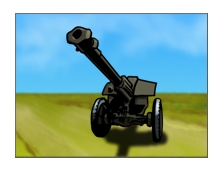
 Welcome back to Advanced Tactics Gold college! In the last lesson we discussed the use of tanks. We have seen that enemy tanks are usually able to defeat, outmanouver and encirlce any infantry based army you might have. The obvious counter strategy when faced with enemy tanks is to build your own tank army. However you might be pressed for raw materials, have oil shortages, or more likely: you might have another front to worry about that requires all or most of your tanks.
 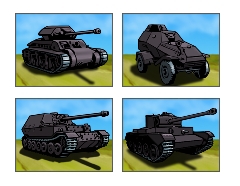 Welcome back to Advanced Tactics Gold College! Today we will be looking a bit closer at tanks. The first thing to notice about ATG is that there are quite a lot of different types of tanks. The core types of tanks are: the armoured car, the light tank, the medium tank, the heavy tank and the tank destroyer. In this lesson you’ll learn when best to build what type of tank. In this lesson I will be referring to armoured cars as tanks, I hope the reader will bear with me and accept that the armoured car could be seen as a very little tank on wheels.
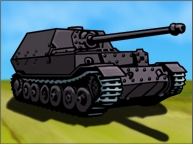 The Tank Destroyer deserves some special attention. This tank is specialized in attacking enemy tanks. It performs well in offensive and defensive use, but versus enemy tanks only. It is superior to even the Heavy Tank. For example: 2 Tank Destroyers attacking 2 Heavy Tanks have a chance of 65% of success. However tank destroyers are especially vulnerable against infantry counter attack.
 Welcome back! I enjoyed writing the first Advanced Tactics Gold College lesson so much that I turn to the second lesson ahead of schedule. Today we will discuss mortars and machineguns. Both troop types only require research to produce them if you are playing a stone-age game, otherwise basic research is already acquired at start of a game. Although these troop types require raw materials, the requirements are very low: machineguns require 1 raw unit and mortars 2 raw units. Production cost for machineguns is 250 and for mortars 500. (rifles & smg’s cost 100)
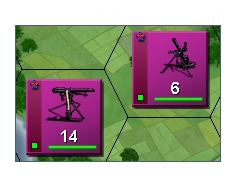 At best I would add about 1 mortar to every 20 rifle just to let them build up experience by continued kills and survival due to being a “rear area” type. To be honest I would in most circumstances advise players to not buy to many mortars. They are relatively expensive compared to their effect and they require expert play to squeeze out their few relative advantages.
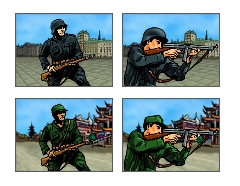 Welcome to Advanced Tactics Gold College. I am planning to give a number of lessons that will help the novice player with his strategy and tactics. Probably most of these lessons will also be usefull to more experienced players since I regularly note that even experienced players sometimes miss important things. I will start this ATG college course of with a discussion of the different types of equipment and troops available to you. Today we will start easy and discuss rifles and submachineguns (SMGs).