How to Make Logistics Fun

Decisive Campaigns III design blog #5

Now might be a good time to have a chat about logistics. This is a very difficult concept to get right in games.

Most people tend to bounce off logistics faster than a rubber raindrop. Wargamers have a higher tolerance setting but not by that much. Logistics aren’t inherently fun and they involve, typically, big doses of micromanagement.

Yet they are always present in one form or another in wargames as it’s difficult to do justice to your chosen topic without a logistical system of some kind.

An awful lot of wargames tend to take the easy way out and provide a token, bare basics, logistical model. Which is O.K for a lot of situations and ensures that game play isn’t affected by the Many Tentacled Logistical Beast. The designer has ticked the box without managing to upset anybody.

Unfortunately this isn’t a route that can be taken with a game simulating the invasion of Russia. For Barbarossa this is a make or break topic as it was a key plank of the campaign. There is going to have to be a decent, detailed, model lurking in there somewhere.

The overall design of DC3: Barbarossa has, at it’s core, a rabid desire to strip out all forms of micromanagement. This is a GOOD THING but it puts a ball and chain around the implementation of an involved logistical system. How do you manage to portray the complexities required without being able to insert a mess of variables that need to be actively manipulated by the player?

The basic requirements for a Barbarossa based logistical system would be that it delves into a higher level of detail than normal, is easily understood by the player and, as mentioned, is micromanagement free.

Here’s how it is done.

Firstly there is an underlying structure. In each theatre, eg. AGN, there is a base, referred to as the ‘Main Depot’. This is a fixed location close to the border that is constant throughout the game. It has as much variability as your local, geologically stable, boring, mountain.

All the action happens at your Forward Supply Base (FSB), which is, once again, unique to each theatre. This moves forwards or backwards according to the whim of the player. The game will offer you, at frequent intervals, a list of possible locations that it can be relocated to. All of these exist on the main rail lines for obvious reasons.

You don’t have to physically move a counter on the map. The decision system handles this for you. There’s an example of how this works in the previous blog post. The map shown dynamically portrays the position of your Main Depot, your FSB and any Panzergruppes.

Which brings up another topic. The logistical system is all about getting enough Fuel to your Panzergruppes. Ammunition and supplies are handled as well but these are secondary issues to fuel.

The Wehrmacht that invaded Russia was a straightforward organisation. There were a large number of slow divisions (line infantry) and a small number of fast divisions (panzer). This was a result of a conscious decision by High Command to concentrate all mechanised and motorised assets into the four Panzergruppes at the expense of everybody else.

It is these four, highly mobile, hard hitting, PG’s which will win or lose the war for you. Attempting to march on Moscow, supported by horse drawn panje carts and a lot of spare shoe leather, would be an exercise in futility hence the strong focus on providing fuel to the Panzergruppes.

Back to the main topic. Your FSB’s will leapfrog their way forward in each theatre as you advance. A simple analogy here is looping a large rubber band over a fixed point at one end and your left hand index finger on the other. As you move your hand forward (the FSB) the rubber band back to your Main depot (fixed point) stretches. The ever-stretching link between the two is your rail network.

How many trains per day are you going to be able to get through the rubber band link? The further you move your Left hand into Russia (FSB) the more tenuous the link will be.

The analogy goes further. There’s a second rubber band looped between your Left hand (FSB) and your Right hand (your PG/s). This link is handled by your truck columns. Advance your PG’s to far ahead of your FSB and your truck columns will struggle to get enough fuel to where it is needed.

Unlike DC1: Warsaw to Paris and DC2: Case Blue, there is no global pool of fuel. Instead there are individual allocations to each theatre (which you can change via decisions) which then have to be rail freighted from your Main depot, along the first rubber band, to your FSB. From here it needs to be shuttled via your truck columns along the second rubber band to your PG HQ’s.

Whatever Fuel makes it to your PG HQ’s is what your fast divisions draw down from. As time goes on you may well find that you have plenty of Fuel but it’s either stockpiled back at your Main Depot or at your FSB, because your trains or truck columns are unable to move it forward. You’ve overstretched your rubber bands.

So there is the basic structure – Rail link from Main Depot to FSB, truck link from FSB to PG’s.
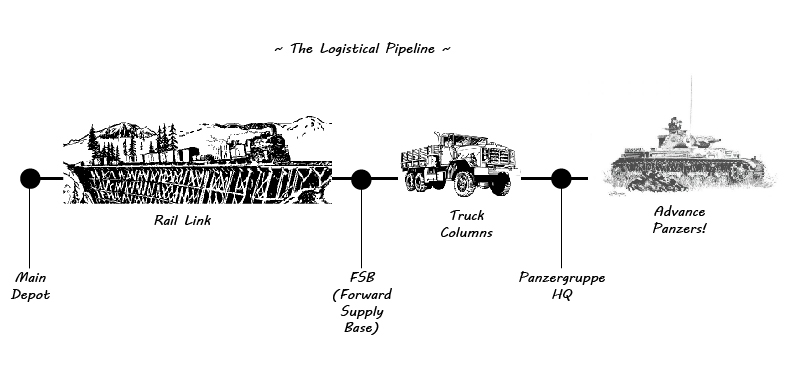
logistics_pipeline

All of this is handled automatically by the game. The Player is given plenty of feedback on what’s happening and can, if desired, delve down into the nitty gritty detail and immerse themselves in the numerical soup bowl. Importantly, the Player doesn’t have to.

They can, if they wish, approach the logistical system solely as a high level operational matter.

To enable this we have, with a flurry of trumpets, the DECISION system. This allows the game to throw all kinds of logistical detail at the player but in a straightforward, easily digestible, manner. Decisions are micromanagement free zones. A previous blog post highlights ‘Tires for your Truck Columns’ as one example of this.

The Player makes a decision on Tires and this flows directly into the Logistical system. There are a heck of a lot of decisions covering all aspects of the system that will occur as the game progresses.

Design wise, we now have a pretty good simulation of the logistical difficulties with no micromanagement involved and with the player having input into all the key factors via the Decision system.

To enable them, if they wish, to get a closer look at the inner workings and to see the effect of various decisions that they make, there are many detailed reports. With numbers. Lots of them.

I’d call this a win but only a marginal one. It’s interesting and playable but it isn’t necessarily fun. Not yet.

To make logistics fun you need to get people involved. People under stress. Sometimes they are happy but mostly they are grumpy. Who are they angry with? You. Why? Because you’re the person in charge.

The logistical system described above is practical, functional and playable. But it’s just a bunch of numbers being manipulated and shuffled around. Now place a person in charge of each part of the system and, all of a sudden, it comes to life.

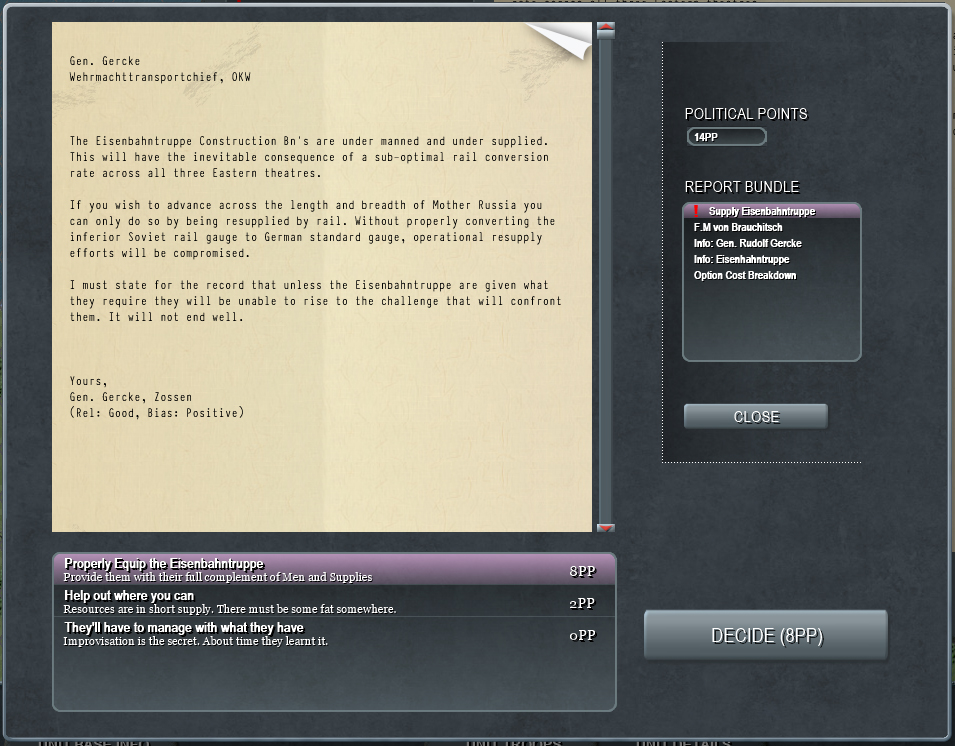
There is a problem with scheduling on your rail network? Rather than this being another set of numbers indicating a problem, you’ve got a report in front of you from General Gercke who is DEMANDING you take action against the dorftrottel’s who run the truck columns. Which would be General Wagner and he’s FURIOUS with the lack of consideration being show by General Gercke’s transport staff who run the rail network.

YOU get to decide how to untangle the mess. Whatever you do will have consequences, not just with the provision of fuel but with your relationship with both men, as well as your theatre commanders. Relationships have consequences. Good begets good and bad begets headaches.

You are no longer interfacing directly with the logistical system. You have lost your god like powers to manipulate the underlying numerology. Instead, just like in real life, you have to ask/cajole/order/plead with a small, eccentric, cast of characters to do your bidding for you.

Now it’s fun.

Cheers,
Cameron

Posted in DC:Barbarossa, Game Design | 6 Comments

A quick update on Shadow Empire

Shadow Empire design blog #3

Just a quick word I am still alive and kicking. Designing a new engine is not easy. I have to juggle a lot of different tasks at the same time, but slowly everything is moving forward and integrating. The unit and landscape map artwork is close to completion, I am almost halfway through with the design of the campaign scenarios and the random game maps are starting to become more and more interesting.

The gameplay has had some live testing against friends and with a few select alpha testers from previous games. And it is good! As you might remember there are 3 modes of play: simple rules, basic rules and full rules. Especially the advanced parts of the rules need more fine-tuning. They were often a bit to overwhelming and confusing. But I am making a lot of changes for the better that keep the depth but provide a more tranquil playing experience.

I guess everything is taking a long time because I am not choosing the easy route very often. With the landscape artwork for example I chose to have dynamic generation of maps, but also dynamic generation of some hex tile artwork, moving water and quite some animation with some units and locations.

The same for the campaign. Definitely not the easy route… Every scenario has a semi-randomized map, meaning that the core logic of a scenario stays the same, but every play is subtly different. The campaign comes with a story that can be influenced by the player. Every scenario is a little mini story where you can actually make some choices and in between the scenarios you’ll find some time to wander around your base and talk with your leaders.

Big task ahead of me now is the creation of the final user interface. Moving your units around on the map is already a pleasure, and just a few days ago I worked on improving the flow for combat. It is quite amazing how approaching combat between two units like a little movie script pays off. Also experimenting with some audio feedback. Which works amazingly well, although I get tired of my own voice used in the placeholders. It is a lot of work to make sure the key rules are visible and audible to the player, but it pays off. Also a clear game flow and visibly transparent rules makes me reflect more on my own design and it already happened quite a few times a change in the game flow or interface also caused a change in the game rules.

The interface and the game flow are the areas where I really try to make an enormous improvement compared to earlier engines. We will soon see if I succeeded or not :)

Best wishes,
Vic

Posted in Uncategorized | 1 Comment

Russia on Ten Barrels a Day

Decisive Campaigns III design blog #4
Note: Screen shots show an Alpha version with graphics being either missing or subject to change. Except for a few stragglers, the Soviet military forces are otherwise occupied. Somebody mentioned Manchuria.

Let’s invade Russia. Right now. While nobody is looking.

The bulk of the Wehrmacht can sit this one out. All we’ll need are the four hard hitting Panzergruppes.

Russia. Empty. Nobody home. Drive straight down the main road. All over in a fortnight.
Knights Crosses, first class with Golden Oak leaves all around.

Glory awaits.

How hard can it be?

D+0
blog_1

All Panzergruppes report in at one hundred percent operational capability. Ample fuel. Morale excellent. Smartly creased uniforms. Square of jaw. Stare down the sun expressions. Forward!

blog_2

The weather forecast is all roses and sunshine. Kiev is the place to be. Warm, almost tropical. The Abwehr informs us that they’ll be girls in bikini’s waiting to drape flowers garlands over we steel-eyed warriors as we roll past in our shiny Panzers.

D+4
blog_3

Minor resistance on key avenues of approach. Nuisance value. Envelop and eliminate. The men are enjoying the outing and the opportunity to fire their weapons.

D+8
blog_4

Now that the Luftwaffe has achieved air superiority we’ll switch their focus over to providing Tactical support to our fast advancing Panzergruppes.

blog_5

Glancing at Armeegruppe Nordwärts, we find that the Luftwaffe is all conquering. Nearness to the main theatre airfield, the excellent flying weather and the well prepared airbase all combine to give Col. Gen. Hoepner’s 4th Panzergruppe an iron fist as he steamrolls through the token Russian resistance.

Everything is right in the world, The Fuhrer is, we have been informed, bouncing off the walls with excitement and contemplating pushing the Bolsheviks even further eastwards, beyond the Urals.

blog_6

Col. Gen. Hoth’s 3rd Panzergruppe, thrusting eastwards in AGC isn’t gaining the same benefits from his close air support due to an increasing distance from the main AGC airfield and poor weather. Even so, the Luftwaffe clearly rules the skies.

D+12

We are suffering some schedule slippage. There are cracks developing in the master plan. Not many, but enough to create some concern.

Col. Gen. Hoepner’s 4th Panzergruppe at AGN is suffering it’s first bout of mechanical failure. Panzers, sadly, aren’t built like Volkswagens. On the other hand Volkswagens don’t have to thump and bump their way cross country at a rate of knots.

blog_7

Of greater concern is Col. Gen von Kleists 1st Panzergruppe down in AGS. They appear to be outrunning the ability of their truck columns to keep them resupplied.

blog_8

This is a matter that warrants further investigation.

blog_9

The situation is somewhat stretched at AGS but still manageable. It is important that the Col. Gen. Kleist maintains his momentum. The Führer demands it!

blog_10

It may well be worth moving the AGS Forward Supply Base up to Lvov as Kleist is going to be beyond Krakau’s ability to support him within the week.

Right now all our FSB’s are still behind the border and it’s our truck columns that are doing the heavy lifting. General Gercke and his trains will have to take up the slack sooner or later.

blog_11

Col. Gen. Kleist has broken through and is sending back reports of endless rolling steppes. He appears to be concerned about the vastness of Russia.

The man is clearly dreaming.

To be continued…

Posted in DC:Barbarossa, Game Design | 9 Comments

Small General has moved over to Slitherine

Eastern Front!You can now find both the 2 Small General titles in the Android Slitherine store. If you wonder why I moved my titles to Slitherine? Well… of course I have tremendous trust in my publisher, but also its the simple matter of removing myself of the burden of some administration and tax issues :) Anyway the games stay the same :) They even retain their old links to the android store.

Posted in Small General | Leave a comment

Let’s Talk about Tires

Decisive Campaigns III design blog #3

Assume that you’ve been left in charge of a big lump of machinery. There are pipes and valves everywhere, steam vents abound and there are a multitude of gauges and controls. It’s a complicated mess of equipment and you know that you’ll be spending a lot of time twiddling the controls to keep it running. This was me quite a while ago. I spent most of a four hour watch period in a never ending feedback loop, chasing my own tail. I’d tweak a control then run around and check gauges. Tweak a few more controls, check again. I never really managed to extract myself out of the loop by achieving an ideal set-up as the dynamics were constantly changing. It turned me off a career as an engineer.

Now consider the same piece of complicated machinery. Instead of having to run around a noisy, hot, dirty engine room there’s an air conditioned control room with a window and a coffee maker. All the information you require is right there on a screen. The multitude of controls have been semi-automated. Instead the Engine Control Room program running the whole show pops up decisions from time to time. It tells you that something is out of whack and asks what you’d like to do about it? Instead of drowning in micromanagement you are making high level decisions and letting the ECP take care of the details.

It would, however, be unwise to be lulled into a false sense of security. The Engine Control Program, left on it’s own, will, sooner or later, bring everything to a grinding, screeching halt, typically followed by a fire. You still need to know what you’re doing. You’re still in charge, all that’s changed is that the system allows you to concentrate on the decisions that matter rather than spamming you with micromanagement irrelevancies.

Which is the game.

Decisions that matter. Strong feedback. Micromanagement not found at this address.

It actually goes further than simply providing a bunch of decisions. The focus of the game has shifted. The game has been streamlined. The number of units on the map has been reduced to the minimum number required for the AI to function effectively. Entire sub systems have been abstracted. The composition of units has been reshaped and smoothed over.

About now you’ll be reading this and thinking that the game has been turned into the kiddies version of War and Peace, that there’s no longer a game there, not a real man’s game.

Nope.

Real men, men that slurp straight whiskey out of a dirty glass and spit ‘baccy onto the floor, would be happy to play this game. There are detailed and complex underlying mechanics. Right down to worrying about the supply of tires for your truck columns.

What there isn’t is micromanagement. What there is are decisions. Decisions without the fiddly bits.

Take the Tires as an example. It’s a good one to use as, on a scale of one to ten for potentially interesting game decisions, it would be down there among the dead men. If I had to pick the most boring decision in the game, Tires would be it.

Who the heck wants to be bothered by Tires? How can that be made even vaguely interesting? Does it even matter?

Lets see how successful the game is at turning Tires into something you might want to care about.

tire_1
(click image to enlarge)

Up front you’ve got a report from General Wagner, your Quartermaster General. Over to the right in the Report Bundle are other reports. There are always at least two, often more, and they can be supplemented by a range of other messages. Here’s the second one.

tire_2
(click image to enlarge)

This one is from Mr. Funk. He’s sounding stressed. As befits a person with such an unfortunate surname.

A couple of reports from interested parties have reached your desk and a decision is required. Note that there is little agreement on a way forward. This is typical of a decision. If it was straightforward and obvious, your staff would have already taken care of it. As you’re the man in charge you get to resolve the curly ones.

If you glance back to the first screenshot you can see a range of options down the bottom left. For Tires it’s a case of who do you give them to? Why is there a choice anyway?

Historically the Germans divided Russia into three distinct theatres.

tires_3

Decisive Campaigns 3: Barbarossa, with its strong operational focus, enforces these boundaries. Three theatres, each with their own command structure, their own logistical system, air, artillery, internal security systems, etc. Units from one theatre wandering into adjoining theatres will cause your organisational fabric to rend and tear.

Yes, it’s possible to shift a Panzergruppe from one theatre to another, as was done at the time, but you’ll need to obtain permission first. That’s a decision.

Back to the Tires. Three theatres, each of them in need of tires but there’s only enough tires to supply one.

Well that’s a resource allocation decision which is a bit more interesting but I’m sure that Tires still haven’t lit your fire.

Have another look at the first screenshot. The options. If there are three theatres then why do the costs differ? Surely it would be the same cost for each?

Here’s why.

tire_4
(click image to enlarge)

Each decision has a full breakdown of why a particular option costs what it does. You can see different factors at play here. There is a base cost. This is fixed. Costs vary depending on what level of time and Command Authority are required on your part. A base cost of 3 Political Points is considered a low level decision.

Cost is important because you have a limited amount of Political Points. Not enough to go around. There are considerable demands on your time and authority and you’ll have to pick and choose where to spend your limited command resources.

Any decisions that you don’t get around to making are delegated down to your Chief of Staff who will make a decision on your behalf. Perhaps not the one you’d prefer. Will he win the war for you if left on his own? Like the Engine Control Program, it won’t end well.

Talking Tires, the first decision is whether you’ll even want to deal with it personally or whether you’d be best to delegate. How important are Tires? On their own, not much but your truck columns don’t tend to go very far without them. These are the same truck columns that are currently shuttling fuel to your Panzergruppes from your Forward Supply Bases.

Let’s assume that you feel the need to take control of the Great Tire Crisis yourself. Decisions generally involve you asking/ordering/requesting somebody to take a course of action, in this case, your Quartermaster, General Wagner.

If you glance back at the Option Cost breakdown above you see that your Good relationship with General Wagner has resulted in a cheaper cost. He’s happy to help.

The game tracks your relationship with a number of key characters and where you sit on the relationship spectrum has significant ramifications.

Let’s take a look at the cost of resolving the Tires conundrum at a time when General Wagner is no longer sending you birthday cards.

tire_5
(click image to enlarge)

Tires, and all other decisions involving General Wagner, have suddenly become a major drama. Because your working relationship has effectively broken down it will take a greater amount of your time to cajole him into doing something that he’d rather not.

The technical term for this is Command Friction but you can experience it at home. Ask your better half to pass the salt to you at the dinner table tonight. You’ll either get handed the salt shaker with a smile or be rapidly calculating incoming ballistic trajectories depending on your relationship level.

Well if Tires are that important you could resolve to remain in General Wagner’s good books. Which is achievable but at a cost of other relationships. There is a war on. People are under pressure. They have their own agendas, their own priorities. There are underlying fault lines in the historical command structure of the Wehrmacht that virtually guarantee that not everybody will get along.

Assume that you’ve given the Tires to Armeegruppe Zentrum. They’ll be happy. But the commanders of AGN and AGS may not be. Relationships will change. Choose to do nothing and General Wagner might get upset at the lost opportunity.

Then there is the Führer. You’ll notice the option costs are affected by his strategic vision of what you should be doing in Russia. An option in line with his thinking will be easier to achieve, decision wise than one that contradicts his preferred approach.

In both the above examples he has similar priorities but this isn’t a given. He’ll call conferences from time to time to discuss overall strategy. His priorities will change. There are opportunities to influence his thinking. More on this later.

The Tires decision is one that will pop up occasionally depending on available rubber stocks. Each time it occurs you’ll have a different relationship with General Wagner. The Führer will be leaning this way or that. Other factors, not show could be in play. Your need for Tires in a particular theatre will vary as will your relationships with the three theatre commanders. Your pool of available command resources (PP’s) may be adequate or nothing but a stagnant, frozen pond.

Each time you play the game the decision over Tires will vary. This isn’t a decision system that devolves down into a puzzle that needs to be solved in order to find the correct path. It’s extremely dynamic and deliberately designed to keep you juggling more balls than you can handle. It’s inevitable that you’ll drop some.

But that’s Operational Command.

If it was easy, everybody would be doing it.

Cheers,
Cameron

Posted in DC:Barbarossa, Game Design | 13 Comments

“CAN SOMEBODY PLEASE TELL ME WHY THE HECK MY PANZERS HAVEN’T GOT ENOUGH FUEL?”

Decisive Campaigns III design blog #2

What determines if a game is enjoyable? Well that depends on the type of game. For a Shooter you are after adrenalin, tension and action. For a strategy game, which is more of a slow burner, there is a different set of criteria. These differ from person to person but immersion and decisions would be on most peoples lists.

Immersion because nobody wants a dry, mathematical based exercise in counter shuffling. You want to, ideally, put yourself in the shoes of the commander of the day and breathe the smoke and worry in the room that comes from a group of concerned subordinates, fretting, huddled over a situation map.

If mechanics are the bones of a strategy game, Decisions are the meat. They provide the muscle that propel it forward.

There are games out there where you can toggle a few switches, crack open a beer and sit back and watch it all unfold, doing nothing, deciding little. More of a movie than a game.

Then there are other games where you find yourself in a veritable snowstorm of decisions. But just like snowflakes on a sunny day each decision melts into insignificance leaving nothing but a wet dribble on your hand. You might as well get your dog to bang the keyboard and make them for you.

The sweet spot is somewhere in the middle. Decisions that are both interesting and meaningful.

The whole design of Decisive Campaigns III: Barbarossa pivots around this concept. Vic has extended the engine to accommodate the strong emphasis on decisions.

promo_decision_system_small
The new Decision system interface (click image to enlarge)

Decisions need a context. Ask somebody to choose red or green and you’ll get a question straight back, ‘red or green what?’.

In Decisive Campaigns III: Barbarossa the context is the player as the Operational Commander. You are in charge of the conduct of the Eastern front but you aren’t an omnipresent God. You have subordinates and you have superiors.

Imagine yourself – mid morning, a murky mug of ersatz coffee in hand, staring as junior Oberleutnants mark the latest updates on the big operational map smeared across the wall of your drafty headquarters. Squinting suspiciously at the growing pile of reports on your desk. There is another pile, equally as big, full of requests. The phone rings constantly. Your staff are spiking teletype printouts ever higher and Colonel Rat Face, currently in dispute with your Quartermaster-General, is impatiently waiting for you next door, demanding that you intervene.

That’s the game. Right there.

Each turn you are presented with a number of decision that cover a broad range of topics. The kind of decisions that an operational commander would face. Every decision impacts the game in one form or another. They matter.

You have limited time and command resources. There will only be so many decisions in a given turn that you can deal with. The rest you’ll have to delegate. Deciding where to spend your command resources and which decisions you’ll have to handball across to your Chief of Staff are key elements of the experience.

You’ll be dealing with people. Strongly defined personalities. People under pressure. They can be difficult and demanding. You aren’t going to be able to please everybody. This has consequences.

Once you’ve dealt with all that you can get down to business and happily shuffle some cheery looking Divisional counters around the hex map that comes with free chocolates and the most detailed climatic model this side of the Urals.

But some of those Divisions aren’t going to want to move. Perhaps you shouldn’t have delegated that particular decision. Damn.

AND CAN SOMEBODY PLEASE TELL ME WHY THE HECK MY PANZERS HAVEN’T GOT ENOUGH FUEL?

Because there is a shortage of signals on the Army Group North rail network it appears that there has been a collision. Deliveries have been delayed. Because you chose to allocate the limited Signalling supplies to F.M von Rundstedt’s Rail Construction Battalions way down South several weeks ago. Because it was easier to do that than send them North when the Führer had shifted his priorities to the Ukraine. Because you have a better working relationship with F.M von Rundstedt than the overly cautious whinger who is holding down Armeegruppe Nordwärts.

Above all you are in COMMAND. It is this gnarly, gritty experience of front line operational command that the game seeks to capture.

Cheers
Cameron

Posted in DC:Barbarossa, Game Design | 4 Comments