Decisive Campaigns III design blog #9
In Decisive Campaigns III you are dealing with Armies. They each have a Commanding Officer. Nobody wants blancmange Officers in charge of their Armies. Having the same General Blobbo with the same blobbo lack of characteristics in charge of every Army isn’t much fun. It’s safe to say that we all prefer a measure of individuality. Some way of delineating this Officer from that one.
This creates a design dilemma. The Germans have around twenty Armies, each with it’s own Commanding Officer. I can easily give them all a set of numbers representing various characteristics but that’s a lot of numbers.
When are those numbers used? Are they turn by turn modifiers for various acts that the divisions under their command perform? That’s a pretty obvious route to take, give an Officer an offensive or defensive bonus that peculates down to all it’s divisions.
The disadvantage of this approach is that it’s very passive. The Player has ‘x’ Army with ‘y’ Commander and he gets ‘z’ bonus. What decisions can he make here? Swap Commanders willy nilly between Armies until he gets the right combination of bonuses where he wants them?
Well that might make sense if the game was pitched at a lower level but Army Officers weren’t flipping around the place like contract cleaning ladies as a rule. Whoever was in charge of the 9th Army, for example, at the start of the campaign was likely going to be the same person in charge at the end of the time period portrayed by the game. Not much scope for interesting decisions here.
Another way of tackling the problem is to use Action Cards. Each Officer can get access to a different hand drawn from a deck of Cards. This is the approach taken by the previous Decisive Campaign games and it works well with the cards adding variety and interest.
However the current iteration of the series has a strong focus on Command Decisions. With twenty odd Officers, each having their own set of cards, this isn’t really Command, it’s more like busy work.
I’ve taken a different approach.
In Decisive Campaigns III each Army Officer is treated the same. Yep, hello General Blobbo. This is clearly not the case in reality but from the perspective of the Operational Commander of the entire Eastern Front, an Army Officer is an interchangeable cog in the big machine. He has to deal with what he’s got and he’s isn’t going to send the 9th Army over there just ’cause it’s Commanding Officer is better at Defence.
From a long term, strategic, viewpoint he might but it would be unfeasible from a tactical point of view as Armies aren’t something you can shove around here and there. They’re big, gnarly, inflexible organisations of thousands of men which move with all the grace of a beer-gutted, club footed, ballerina.
But…
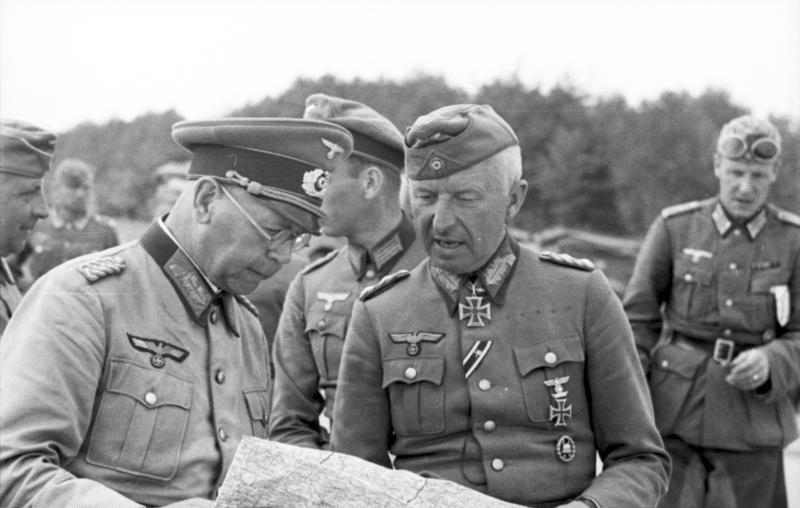
An Army is part of a larger Theatre. an Army Group. The Theatre Commander, for example F.M von Bock of AGC, has at his disposal a range of theatre level resources. At any point in time he could decide to focus on a particular Army within his group.
Doing so might entail releasing specialist battalions, prioritising logistical support, allocating staff time to facilitate plans or simply giving the Army Officer their head. Whichever way it happens he is putting his finger on the map and allowing this Army and it’s Commanding Officer greater operational scope.
Game wise the Army Officer, who indeed has a unique set of numbers, is given a set of Action Cards. The Cards he is given depend on his current Posture. The numbers influence the effect of the Cards.
This isn’t a lot different from what I’ve previously described but the key point is only one Army in each Theatre can have focus. This means you are only dealing with three Armies at a time that have Action Cards, not a whole tribe of them.
The set of numbers that defines the individual Officers also only comes into play when an Army has focus and a Tactical Card is played. An Officer, like anyone from a lowly grunt all the slippery pole to the top, will only shine when they are given sufficient space to do so.
Do you want a cookie cutter, generic wife or girl friend? All you have to do is insist that she dress in the same work clothes every day, talk over her every time she ventures an opinion and demand she serves beans for dinner at five o’clock every evening. With sauce.
On the other hand if you leave the choice of clothes, dinner and opinions to her good self you’ll find yourself with a unique individual. Hey, it may even be you doing the cooking. You do know that real food isn’t fried?
It’s the same thinking with Officers. By focusing on their Army of Panzergruppe you’re giving them room to be themselves. They are no longer just a cog in the machine, they are an individual.
As the overall Operational Commander, the Player gets to decide which Armies have focus. As there is only one per theatre this decision matters. The Tactical Cards that are enabled through this decision matter. Now, with a handful of decisions that have meaningful impacts, we’re close to the sweet spot.
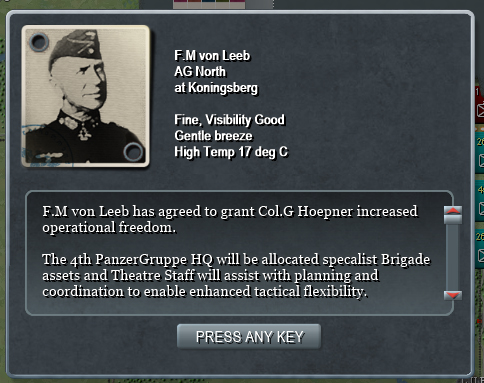
But this isn’t the whole story. The Player, as Operational Commander, is instructing the relevant Theatre Commander to focus on a particular Army. As he’s your subordinate he’ll snap to attention and carry out your wishes. Or will he?
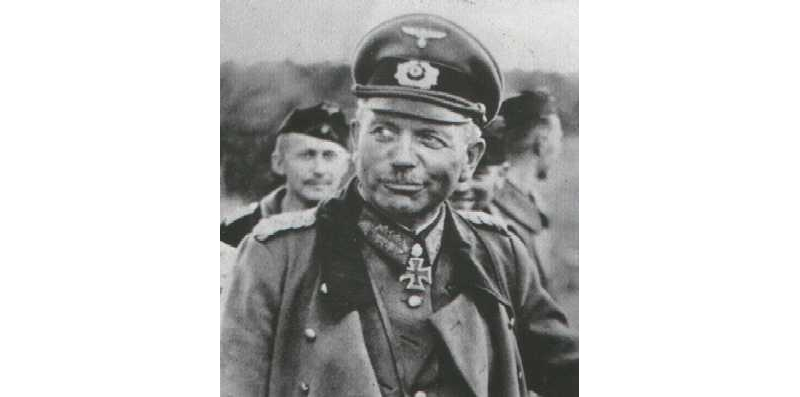
One of the fault lines that ran through the German campaign was the ongoing conflict between the New Age Panzergruppe Commanders and the WWI Old School, Infantry Commanders. Men like Guderian, Hoth and Hoepner were determined to advance as far and as fast as possible in order to sow confusion and chaos. Lagging far behind them were the resentful Commanders of the slow moving Infantry Armies who were left to reduce massive pockets of Russians without the aid of armoured support.
It was a conflict that was never satisfactorily resolved. At times it festered away in the background but it occasionally flared magnesium white hot and people got burnt. Guderian, the leading exponent of fast moving armoured warfare, found himself sacked before the year was out.
As this was an important theme I wanted to model it in some manner. I initially tried calculating the distance between a Panzergruppe HQ and it’s associated Infantry Army HQ. The longer the distance the more strained relationships might become. However this approach ran into spatial problems. Distance needed to be matched with direction. What if the Panzergruppe was behind the Army HQ? Even this didn’t tell the full story because a large distance with the correct inclination still might not make sense if the PG and Army HQ’s were both well behind the front lines.
Too many edge cases. Too complicated. My second pass at it was to wrap the conflict up into a series of Decisions. This was an improvement but it still suffered from the same problem of when to trigger the decisions. Lots of maths, lots of scope to get it wrong. Having a Decision pop-up that is completely out of context is worse than not having a Decision in the first place.
But what if it was tied up with the relationship system? The Player already has an ongoing relationship with the three theatre commanders. By playing a ‘Focus’ card you are asking them to carry out your orders. The theatre commanders were all old school. None of them were inflexible but they all found difficulties in accommodating the new style of armoured warfare with the need to protect theatre flanks.
They’ll happily help out any Infantry Army that you care to Focus on. No problems. These are Armies that need all the help they can get, tasked as they are with reducing the bulk of the Red Army.
But ask them to provide extra assistance to a Panzergruppe raging far ahead of everybody else and their natural instinct to carry out your orders will rub hard up against their fear that doing so will only make a bad situation worse. Those extended flanks that they are personally responsible for will only stretch further.
If your relationship is positive then they’ll grudgingly obey. If, however, you aren’t getting along, this will be enough for them to find a way of saying yes but doing nothing. Experienced subordinates are good at that.
From a gaming viewpoint, when you play a ‘Focus’ card, you can select an Army HQ at any time but you can only play the card on a Panzergruppe if you have a positive relationship with the relevant theatre commander. There are appropriate messages in your Daily Logs indicating which way the wind is blowing.

From my point of view this is a good solution. It’s straightforward, easily understood and gets the message across. It also gives yet another reason to pay attention to your web of relationships.

A counter shuffling experience only really becomes fun, and immersive, once people get involved. The more you can bring these people to life, the better the experience.
Yep, it’s all about People, Planning, Preparation and Persistence.
Then again I’m the person that grew up wanting to be a crocodile wrestler.
“It’s not a l-o-n-g term career option, is it? You might loose an arm.”
‘It’s O.K Mum, I’ve got two of ’em!”
Cheers,
Cameron

Will the Romanian 3rd and 4th armies have their own commanders, too?
Hi Panzeh,
Yep. Dumitrescu, Cuiperca and Antonescu are all in the picture.
Cheers,
Cameron
Thanks again for another good blog, command relationships were critical for the Germans. Command conflict played a big part in the 1940 French campaign, with the Panzer leaders, the Army commander von Kluge, the Army Group commander von Rundstedt and Hitler as Supreme Commander, at odds with each other. The result was the halt order before Dunkirk, which was strategic madness.
The same problem occurred again, as the Smolensk pocket closed in July/August 1941, Guderian was more interested in seizing the Elnya bridgehead, for a further advance, than in closing the pocket. Guderian and Halder were trying to ‘bounce’ Hitler into continuing an advance towards Moscow, however, Hitler insisted on his original ‘Barbarossa’ plan, Directive 21, which had set Leningrad and the Ukraine as the initial objectives. Hitler would not contemplate an advance to Moscow, without first taking Leningrad, and the command conflict delay contributed to the Germans not achieving any of their objectives for Barbarossa.
Stalin’s command relationships were a little easier, with punishment, often fatal, for failure, or even too much success. Interested to see how the cards work in that scenario.
Regards, BJ.
Cameron, I am new to the blog here but have been following all your work. Really Looking forward to this game coming out.
A couple of items I noticed that would like to provide as input as you develop this new Eastern front waregame:
1. I like that you are addressing Soviets encirclements – agree these were not as easy to reduce as first played in your game above. The Germans struggled with these and some of the changes you make should address them – there should be aggressiveness on the soviet side when surrounded – they seemed to at least operate with the attitude of trying to attack even when surrounded initally – it was usually later a few weeks after encirclement when a majority of troops gave up due to lack of supplies – you should at least allow for 1-2 turns before surrounded groups start to lose real effectiveness – you could then play in the cards that you mentioned above.
2. Casualties – whats been fun with WiTE is the casualty tallies – are yopu planning to keep score on total casualties inflicted and incurred in this game? Specifically – troops killed/missing, captured, wounded, key vehicles and equipment (Tanks, trucks, artillery, tractors, AT guns, AA guns) destroyed/captured?
3. Can you use any captured equipment to outfit your units? The germans used a lot of captured trucks, artillery and AT guns from the Russians to good effect – even the Russians used some catured German items such as PZ111 as an SU-76i, etc … Any option for that capability?
4. When does the game actually end? Dec 1941? or does it overlap with DC – Operation Blue? If it goes longer then some of the surround rules will need to apply to the Germans who seemed to hold on way past when it seemed they should give up loactiuons (especially 1941-43).
this is several for now – thanks for reviewiing when you have a chance.
Len
Hi Len,
To answer you questions;
1: Given the divisional scope of the game the question of Soviet effectiveness wasn’t so much their ability to attack but rather their capability to do so in any meaningful manner. In the early days of Barbarossa even non-surrounded Soviet units had trouble coordinating meaningful military responses.
2: The game engine has a built in graphing facility to track casualties. Finessing it, as you’ve mentioned, is something we’re considering.
3: In ’41, from what I’ve read, the captured item of most interest to the Germans was the excellent Soviet trucks that were more reliable and better suited for the conditions. They also ran nicely on captured Soviet fuel (it had a different octane rating to the German fuel).
The game accommodates this and even allows you to argue with your Theatre Commanders over how many captured GAZ Trucks they have to hand over for the greater good.
4. Game ending at present is Feb ’42 which allows for the Soviet Winter Counter-offensive. As we’re still playing around with Victory Conditions and how to avoid the ‘I’ll-either-win-by-‘X’-as-the-Germans-or-Quit’ syndrome, it’s a little fuzzy and may change.
Cheers,
Cameron