 Welcome back to Advanced Tactics Gold college! In the last lesson we discussed the use of tanks. We have seen that enemy tanks are usually able to defeat, outmanouver and encirlce any infantry based army you might have. The obvious counter strategy when faced with enemy tanks is to build your own tank army. However you might be pressed for raw materials, have oil shortages, or more likely: you might have another front to worry about that requires all or most of your tanks.
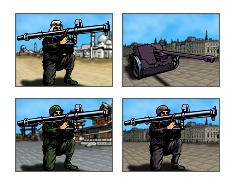
The cheap stop-gap solution versus enemy tanks is to add anti-tank weapons to your infantry armies. Anti-tank weapons come in 2 varieties: anti-tank guns and bazooka’s. Both are cheap in production cost and in raw material use. Bazooka’s are the cheapest and cost only 250 production points and 1 raw material. Anti-tank guns cost 1000 production points and 5 raw materials. Both provide decent anti-tank capability, especially when they are well entrenched. However the core operational downside of both troop types is their lack of mobility.
The lack of mobility means you’ll have to equip your whole front with anti-tank weaponry, while the enemy tank strike is usualy only going to be focussed on a smaller part of your front.
It might thus be a good idea to mobilize anti-tank guns and quickly move them up to the part of the front where they are needed, but the added costs of trucks or halftracks will make this expensive. You might be better advised to construct some assault guns or tankkillers and put those in your mobile anti-tank reserve. Once the enemy has shown the direction of his attack you should drive your mobile anti-tank forces to a hex with high entrench value in the path of the enemy: a town, a forest or a mountain would be ideal.
Now what exactly is the difference between the anti-tank gun and the bazooka? First of all the anti-tank gun is a “rear area” troop type. This means that the gun will live to see another battle when an enemy attack is stopped. So theoretically the anti-tank gun will be able to build up a lot of experience and gain an edge. However in practice you’ll find out that your frontline units will have a hard time surviving blitzkrieg style offensives. Secondly the anti-tank guns are bigger and are quite an easy prey for enemy divebomber attacks. If you do not have air superiority you’d better go for bazooka’s instead of anti-tank guns.
Don’t rely on the anti-tank gun in offensive use. It performs 3x better in defense then in offense. And it truly needs the added modifier of entrenchment to be truly cost-effective. In defense when 5 anti-tank guns with 100 entrenchment are attacked by 5 light tanks the light tanks have only a 10% chance of succesfully taking the hex, on average 2 light tanks (production point cost: 4000) will be lost versus only 1 anti-tank (production point cost: 1000). However the heavier the tanks get the less impressive the anti-tank guns performance will be. When 2 heavy tanks attack 5 anti-tank guns with 100 entrenchment they have 40% chance of succes, on average 0.8 heavy tank will be lost in such an attack for about 1,5 anti-tank gun.
Bazooka’s perform about the same in defense as anti-tank guns, though admittedly they perform slightly less well, and they cannot be protected from casualties for they are “frontline” troops. Compared to anti-tank guns they will have a harder time building up experience.
However bazooka’s can also be used to some extend in attacking tanks, especially when mixed into a larger infantry unit. For example 20 bazooka’s have a chance of 20% of succesfully taking a hex from 5 defending light tanks. Another example: An infantry group that costs the same ammount of production points as those 5 defending light tanks, like 32 bazooka’s and 20 infantry has a 65% chance of succes in the same attack, losing on average 12 troops (production value 2000), while killing 2 tanks (production value 4000). Bazookas will not perform much worse against heavier tanks, unlike anti-tank guns that really lose punch versus heavy tanks. Bazookas use hollow charge projectiles that are deadly to almost all tanks from close up.
My advice is whenever possible to use anti-tank weapons in combination with a small force of tanks in reserve. When the enemy armour attacks and breaks through your lines you should use your (mobile) anti-tank weapons to create a blockage and stop or delay them, while using your own armour to flank the enemy advance and if possible cut-off their spearhead.
Furthermore when on the defense it is always wise to put just one or two anti-tank guns in towns and mountain roads behind your current front, they will entrench up to 200 points when given a few rounds to do so and will then be a very hard nut to crack for any tanks trying to take such a hex by force. Call it insurance for disaster.
As a last note it should also be pointed out that flak guns have some limited value as anti-tank weapons. 3 or 4 flak guns should perform the same as 1 anti-tank gun. When fighting a defensive war without air superiority it is a good investment to buy a little bit more flak then you would normally do since they will help you defend against armoured and air attack at the same time.
Not sure what the next lesson topic will be. I think it is about time to discuss artillery.
Best regards,
Vic


I would prefer AA guns lesson next as they are a bit tricky to use…