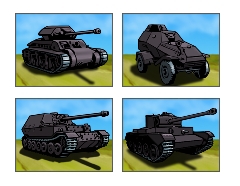
 Welcome back to Advanced Tactics Gold College! Today we will be looking a bit closer at tanks. The first thing to notice about ATG is that there are quite a lot of different types of tanks. The core types of tanks are: the armoured car, the light tank, the medium tank, the heavy tank and the tank destroyer. In this lesson you’ll learn when best to build what type of tank. In this lesson I will be referring to armoured cars as tanks, I hope the reader will bear with me and accept that the armoured car could be seen as a very little tank on wheels.
If you are not playing a stone-age game you will start with the research to produce the armoured car and the light tank from the start of the game. The other types of tanks require research investment before you’ll be able to produce them.
In previous lessons it has become painfully obvious that infantry is very good in defence and “excessive” amounts of rifle or smg are necessary when you try to take ground using infantry only. The core point of this lesson is that you should use tanks to attack infantry. Tanks perform really well in attack against infantry because the armour on the tanks protects them from the small arms fire that the rifle, smg and machinegun defenders put up. For example doing an attack with 10 armoured cars on 100 entrenched infantry has a chance of 80% to succeed and is likely to cause 45 infantry kills for only 2 destroyed armoured cars.
The types of tanks you can build vary from light, like the armoured car to heavy, like the heavy tank. Production cost of an armoured car is just a 1000 production points where as production cost of a heavy tank is 5000. Production of an armoured car costs 10 raw materials per car, while production of an heavy tank costs a whopping 160 raw materials per tank. And although the heavier tanks are much more expansive to build then the lighter tanks they do not perform that much better on the battlefield versus infantry. For example: 10 armoured cars attacking 100 infantry have an 80% chance of success, 5 light tanks versus 100 infantry only have a 55% chance of success and 2 heavy tanks versus 100 infantry only a 30% chance of success. So if your just fighting against infantry make sure to build the lightest tanks possible: armoured cars.
However when your facing enemy tanks the advice is reversed. Heavier tanks perform better in tank-to-tank combat then lighter tanks. This is because heavier tanks have better armour and higher calibre guns. So when facing enemy tanks ideally you will want to field tanks one class higher the enemy is fielding. So if the enemy is fielding armoured cars, you will try to field light tanks. If the enemy is fielding light tanks, you will try to field medium tanks. For example: If you attack 5 enemy light tanks with 5 of your own light tanks the chance of success is 62%. If you attack 3 enemy medium tanks with 5 of your own light tanks the chance of success drops to 35%. If you attack 2 enemy heavy tanks with those 5 light tanks the chance of success even drops to 13%.
So the balancing act a good player has to perform is to find the sweet spot in production choices that makes his tank force as cost-effective as possible versus infantry, but also against enemy tanks, while at the same time not using up to much raw materials. Good luck with this balancing act!
Other advice that is important is the fact that tanks perform a bit better in offensive use then in defensive use. All things else being equal: try to use tanks in offensive use. The heavier tanks are relatively more vulnerable to infantry attacking them then the lighter tanks, so be sure to protect them by adding some sort of support with them like light tanks, machineguns and infantry.
Furthermore tanks are vulnerable to air attack. We’ll discuss that in a later lesson in more detail, but for now its important tot realise that tanks cannot fight back against their nemesis: the divebomber. The heavier tanks are relatively more vulnerable to air attack then the lighter models. Be sure to have air cover for your armoured units or when that is not possible to have flak guns with your armoured formations. Hiding your tanks in towns and forests can also help a lot, when faced with a loss of air superiority.
Talking about landscape types… Its important to realise tanks perform best on flat plains. The more cover the landscape allows the less well the tanks perform when attacking. Forests, swamps, towns and mountains give penalties on tank attack varying between -50% and -75%.
Swamps and Paddies are the only landscape types that give tanks a defensive penalty as well. Swamps and Paddies are normally not accessible by wheeled and tracked subformation types, but when roads are present they can enter.
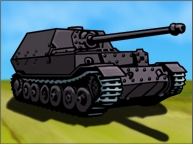 The Tank Destroyer deserves some special attention. This tank is specialized in attacking enemy tanks. It performs well in offensive and defensive use, but versus enemy tanks only. It is superior to even the Heavy Tank. For example: 2 Tank Destroyers attacking 2 Heavy Tanks have a chance of 65% of success. However tank destroyers are especially vulnerable against infantry counter attack.
Assault Guns also deserve mention. They are basically medium tanks that are equipped with a fixed gun, instead of with a moving turret. This gives them a disadvantage in offensive operations, but makes them about as good as a medium tank in defensive use. Its cheaper to produce then the medium tank due to its simplified design. Assault Guns are best used as mobile anti-tank forces or in offensively engaging light tanks and armoured cars. (at the moment the assault gun is slightly to strong, this will be fixed in upcoming patch v2.06)
Super Heavy Tanks are not available to all players. Only players playing a regime ruled by the German people can build these behemoths. They require 9000 production points to build as well as 240 raw materials. You should only build them if you have way to much raw materials and complete air superiority and are facing an enemy with strong medium or heavy tank forces. And to be honest: even in those circumstances I question the wisdom of building these gigantic monsters. The super heavy tanks beats all other tanks including tank destroyers in tank-to-tank combat, however it is vulnerable to infantry counter-attack.
All tanks use oil and you should always keep an eye on oil supply and oil use. Do not build more tanks then your oil stocks can handle. When you are out of oil the tanks lose a lot of mobility and fight with big penalties!
Concluding I want to advice you to exploit the mobility of tanks! Yes armour is good in attacking infantry, but instead of trying to attack the enemy all over the line you should aim to attack at a couple of chosen “schwerpunkten”, annihilate the enemy front on those few hexes and then drive your armoured units deep into the rear of the enemy. Once you have two or more breakthroughs you will be able to connect the pincers of those “panzer drives” and form pockets. Enemy troops captured in pockets will quickly run out of supplies and then will be easy prey even to your infantry formations. Forming pockets is the ultimate way to win!
I hope you learned something today. The next lesson will be on anti-tank weapons.
Kind regards,
Vic