Decisive Campaigns III design blog #11
There has been a dearth of posts from me lately but rest assured I’ve been busy. While the game isn’t finished it’s now in a fully playable state.
Vic and I have been PBEM’ing several test games recently. Which is akin to taking a prototype, new model, car out of the garage for the first time and fanging it as hard as you can down the local highway. The good news is that the engine didn’t blow up, nor did the wheels fall off. It all hung together pretty well although the steering was, in a local colloquial phrase, ‘wonky‘.
Our first game came to an early halt when it became apparent that the Blitzkreig was more of a ‘Fizzer’ kreig. The Germans had enough punch to knock holes in the Soviet lines but there wasn’t enough to fully exploit them with the consequence that their advance was like a strong man trying to run through waist deep mud in order to get to the river.
After a rebalancing, and introducing an initial ‘shock penalty’ to the Soviets, we started up a second game with Vic as the Germans. This time nobody had any doubts about the effectiveness of the opening Blitzkreig. In fact I was worried that I might have gone too far with the balancing as there were massive pockets of encircled Soviets in all directions.
Vic ran the numbers on the casualties and they, to my surprise, turned out to align closely with the historical reality. It certainly didn’t feel right, sitting watching entire Soviet Armies get swallowed up willy nilly. Not a happy time to be playing the Red corner. No wonder there was confusion in the Kremlin in those early days.
The encirclements created their own problems. It only took a round or two and the trapped Divisions became virtual ghost units as they were bereft of supply and fuel.
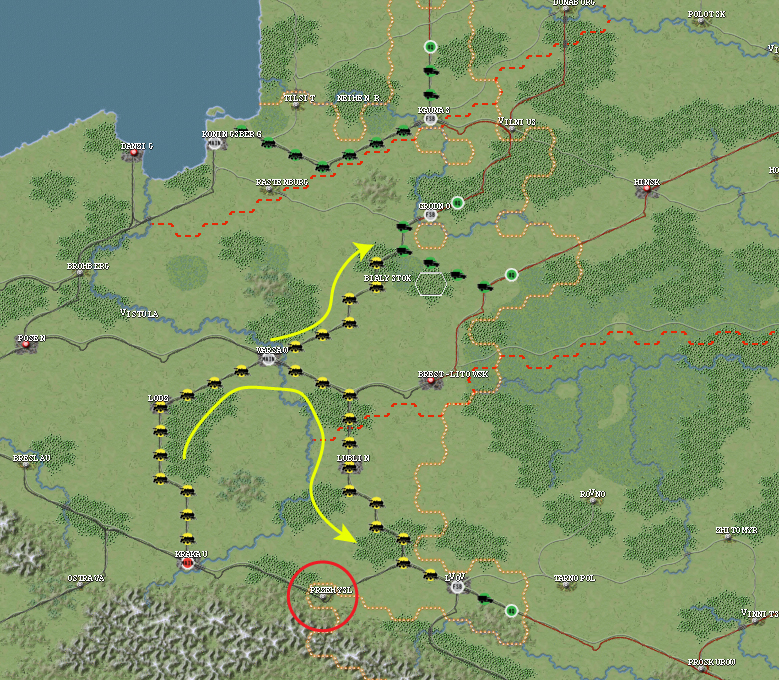
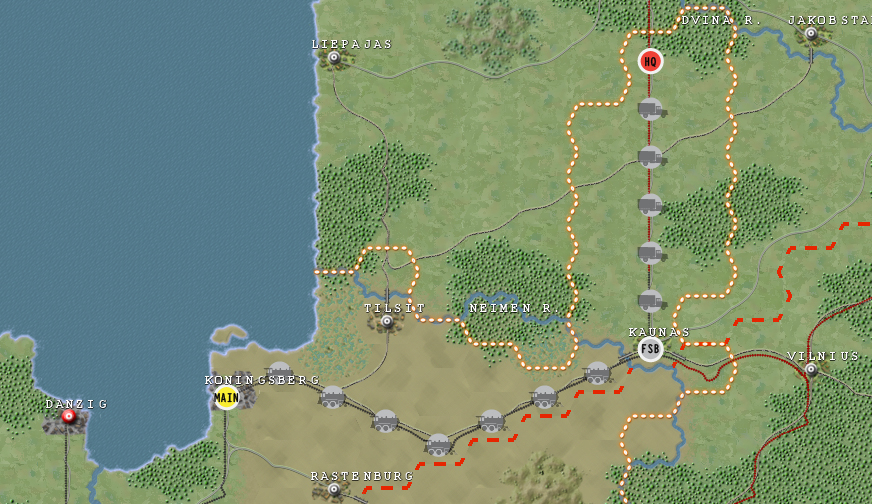
In AGS, Vic swung the 1st PG well north of Lvov and managed to trap large numbers of Soviet Divisions in a huge pocket but, having done so, came to a grinding halt as his Truck Columns, one by one, broke down after having to traverse extreme distances cross country.

It took him another 3 turns (12 days) for his Infantry to reduce the pocket enough for him to clear the rail line. He then had to wait 3 more turns for his Forward Supply Base to relocate to Lvov. Aerial Resupply of Fuel didn’t work way down south as the 1st PG had out run the effective reach of Luftflotte Four and was forced to remain idle until their Logistics were untangled.
Overall this all worked as intended and highlighted the dangers of spearing your Panzers off into the wilds, away from the main transport routes. It did, however, cause a fair amount of discussion about how the game treats encirclements.
On one hand was the German point of view that, once having encircled a pocket, it should begin to dissolve of it’s own accord. On the other was the Soviet player’s opinion that by simply being there the trapped Divisions are serving a useful purpose in denying access to crucial rail infrastructure.
We both found it frustrating that the trapped units were so passive – the Germans because it was a grind having to neutralise them and the Soviets because they couldn’t play any useful role other than that of static blockers.
As a result I’ve added a couple of Action Cards to the Soviets. The first allows the Soviet Player to deliberately ‘Dissolve‘ a trapped Division and have it reform into irregular bands and conduct guerrilla warfare. This allows the Soviet’s to remove a single Division, per turn, and have it add to the Partisan level of the Front.
The game system that handles Partisans hasn’t been mentioned in a blog post yet but there’s a net figure for each of the three Fronts (or Theatres, depending on what side you’re playing). This is dynamically calculated based on the number of captured cities, the policies followed by the German Civil Governors and the effect of any ‘Incidents‘. Offsetting these are the number and type of Divisions you’ve assigned to Security duties. Over time they’ll get better at their job.
If the overall Partisan level for AGC is 11% , for example, then that’s the probability of a Partisan event each round. These can temporarily interrupt your Trains, permanently destroy your Truck Columns or cause casualties to your Rail Construction Battalions.
So from the Soviet Player’s perspective having the ability to deliberately remove a Division in order to influence the effect of Partisans is an interesting cost/benefit decision that makes encirclements less of a passive occurrence. It also provides a short term boost to the German’s situation at the cost of a long term hindrance.

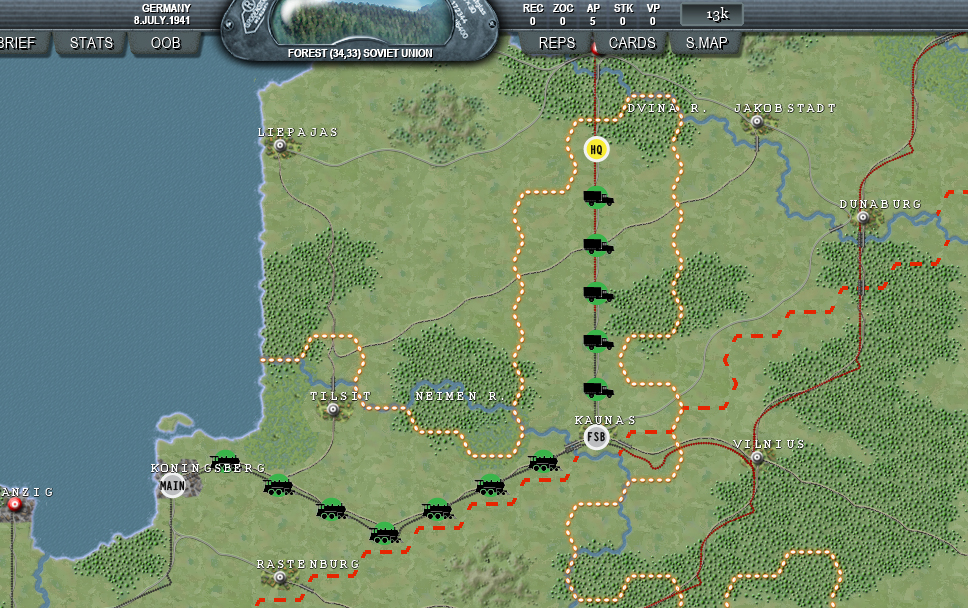
Knocking on the Gates of Leningrad. Note the Finnish units held back by Politics
Encirclements have been given an even bigger profile with the addition of the second Action Card – Breakout! Vic made the astute observation that there were many instances of Soviet forces conducting violent breakouts after being encircled for several weeks or more. This isn’t something that could happen at present, in the game, due to the deleterious effect of no supplies.
Hence the Breakout! Card which allows the Soviet player to choose a single Army HQ (once a turn) and have it resupplied (along with any subordinate Divisions) and given a moderate action point (movement) bonus.
The catch is that the Army HQ must be located in a city or town. Aerial resupply was a non starter for the Soviets in the early stages of the campaign so the only other potential source of supply and ammunition would be from magazines located in urban centres.
While this might not be historically accurate (I couldn’t find any information to prove or disprove it) it’s a good game outcome. The Soviet Player, if he’s careful, now has a limited capacity to make a surprise counterattack from within an encircled pocket. This is no small thing as, in our game, Vic ran his Panzergruppes way forward of his infantry, exposing more flanks that a Saturday night hooker, confident that any encircled Soviets would be glued to the spot.
Any breakout would be a do or die attempt given the one time supply and movement boosts but it’s enough to provide the Soviets with some counter play and to keep the Germans on their toes.
Both Action Cards will be free to play which is a direct result of another balancing issue that arose from the encirclements.
A key plank of the game design was the German Player taking the role of the Operational Commander of the Eastern front. Lots of decisions to be made with the currency of decisions being Political Points (PP’s). To make this work there needs to be an element of resource scarcity. Lots of decisions that need to be made but not enough PP’s to go around.
The scarcity forces you into compromises. You’d like to do this but you can’t afford to because you also want to do that. There are times where you’ll have to go with a worse option because that’s going to be better than doing nothing or delegating the decision to your Chief of Staff.
It’s having to make the tough calls that give you the sense of being in Command. It’s where the real juice of the game is.
Or should be. I stuffed up. Hitler’s first Directive (no. 21) gave destroying the Soviet Armed Forces as his top priority. For each Division Vic wiped out he received 4 PP’s. Guess how many Divisions went down in the first five turns?
Enough to make Vic the German equivalent of the kid in the candy store with his pockets full of money. He could afford to choose any option for any decision at any time.
It was like putting Warren Buffet in charge of my personal stock portfolio. As there are hardly any zeroes involved Warren wouldn’t care what happens to my favourite shares. I’d be asking him to give me an update on my financial position and he’d be staring straight back at me wondering who the h*ll I was and what the heck was was a kangaroo doing hopping past the window when he thought he woke up in Omaha?
I’d reassure Warren that he’s having a Senior’s moment and to concentrate on making me rich but I doubt that it would do any good as he wouldn’t be suffering from any sense of ‘scarcity’.
Yep, there was a great big chunk of the game design totally negated by a simple oversight. Scary how the little things can trip you up.
I’ve changed it such that you now only get PP’s from destroying Army HQ’s, not Divisions. There are still a lot of HQ’s out there but not that many that you can get rich quick off them.
A canny Soviet Player could deliberately choose to pull his HQ’s back out of reach and abandon his Divisions but that would likely prove to be self-defeating (Command and Control wasn’t a strong feature of the Soviet Armed Forces in ’41) and difficult to do anyway – I may have mentioned the ‘Activation’ system for the Soviets in a previous blog.

Smolensk is captured but there is still a distance to go before Moscow is reached
The Soviet side of the game also needed a fair bit of love which is to be expected as it was put together shortly before our games and received only limited testing.
The design gave the Soviet Player a wide range of Strategic and Tactical choices expressed through various types of Action Cards. Stalin (the role you take if you play the Soviets) is only given a small ration of Political Points per turn and, while he has plenty of options, he has limited resources with which to exercise them.
All good. His country is being invaded. He’s been caught with his pants down and chaos abounds. He should be suffering from acute scarcity.
A further aspect of the design was that most Cards, once played, doubled in cost. The idea being that Stalin needs to choose very carefully where and when he deploys his limited Command Resources.
In practise this turned out to be overly proscriptive. Stalin rapidly priced himself out of the market early on and, at the time when he needed certain Command Options the most, couldn’t afford them.
The solution was to tone down the doubling mechanism (there’s a 50% chance of a card doubling in cost, when played vs. a 100% chance as previously) and to make a lot of the lower cost cards free. Stalin now has half a dozen options that he can play at any time, regardless of his Political Point tally. He still needs to be mindful of exercising his big ticket Command Options but they will, on average, increase in cost at half the previous rate.
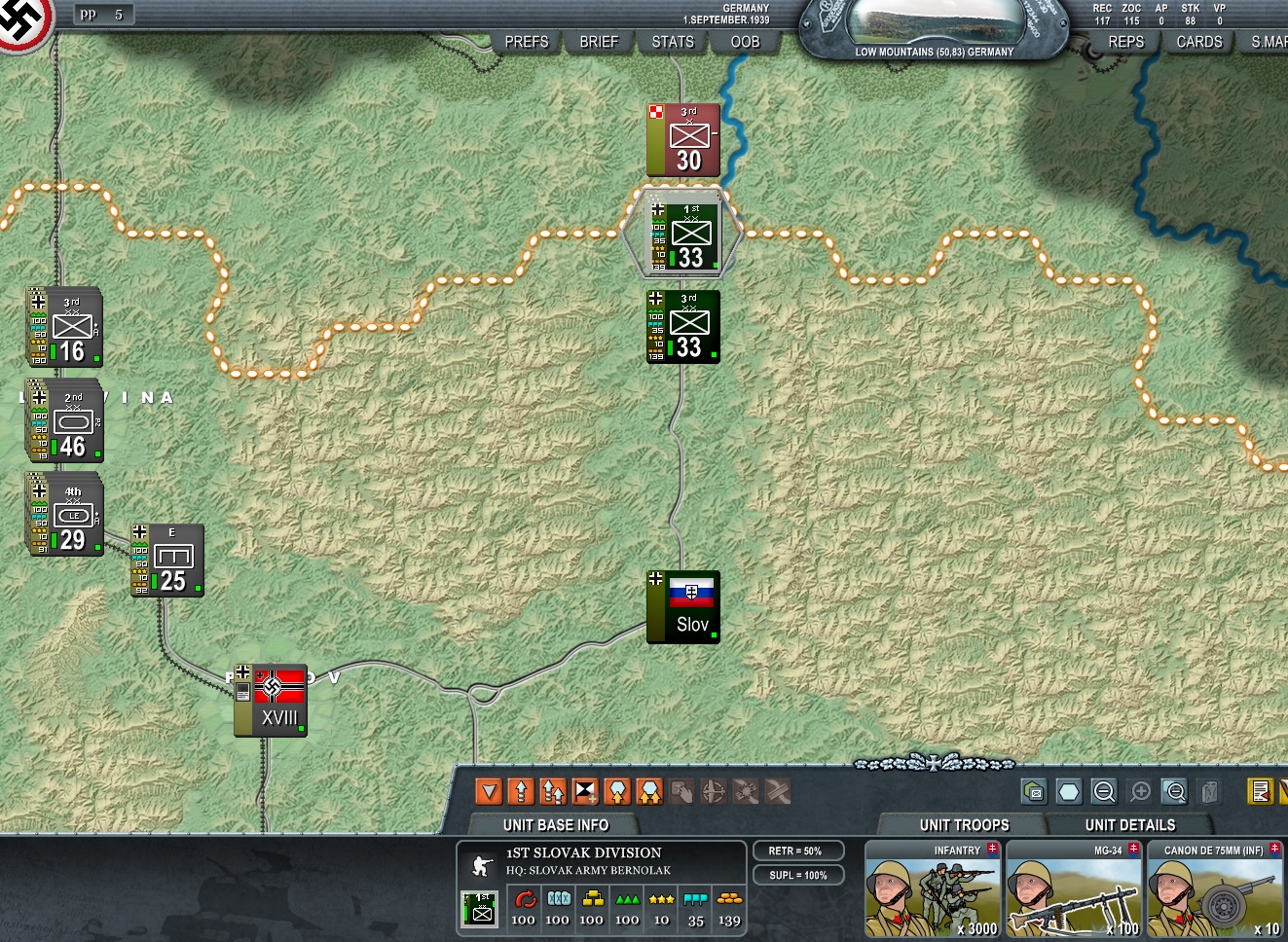
One new card suggested by Vic, is ‘Fortifications’. Once a turn the Soviet Player can construct a sizable Fortification anywhere on the map (provided it’s Plains or Forest, not cut-off and not knee deep in mud). It’s one of the free to play cards and provides a neat little mini-game for the Soviets.
At one Fortification per turn you can decided to ring Moscow and Leningrad with moats and anti-tank hedgehogs or take a more forward approach and recreate the Stalin line. As mud shuts down this option you’ve only got so many turns of use.
At present I’ve allowed it to be played in Snow conditions to reflect the desperate efforts that Soviets took to mobilise their civilian population, regardless of the conditions.
In keeping with the games streamlined approach to ancillary units there are no engineers or artillery units on the map for the Germans. What’s in place, instead, is an automatic reduction in Fortification structural points whenever there is a German unit adjacent to it that is receiving Theatre Artillery support.
It’s assumed that the Pioneer Battalions will swing into action against any fixed Fortifications only if they have sufficient artillery cover (which is my understanding of what happened historically). Hence, as the German Player, you’ve got an incentive to concentrate your Theatre Artillery Direct Fire support in order to deal with Fortifications.
You’re also going to find it difficult to over run Fortifications with Armour alone as Panzergruppes can’t receive Theatre Artillery Support as they were to fast moving for the tractor and horse drawn Artillery to keep up with.
An argument could be made that the Panzergruppes could apply their Tactical Air Support against the Fortifications in the same manner as Artillery. It was the Pioneers that did the damage here, not the brute force of dropped explosives and they could only safely do their job when protected by carefully targeted Artillery support.
You could also, quite reasonably, point out that the Soviets should have an existing number of fortifications already in existence, at the start of the campaign. Which, apparently, they did. Lots of them. Very few of them, however, were in good shape (they lacked steel doors on the bunkers, fire lanes were overgrown, tank traps were in disarray, moats silted up, etc.).
Allowing the Soviet Player the ability to construct his own Fortifications, one at a time, isn’t that far from reality, and provides scope for a range of different strategies.

Praying for Rain. Rostov is currently Hitler’s no.1 priority. As Vic has chosen to support Hitler’s goal, taking Rostov would be a win provided the Führer doesn’t change his mind beforehand.
Another major hiccup with the Soviets, once more a balancing issue, was Stalin losing control and going into a Paranoid Death Spiral around turn five. As the Soviet Player I had immediately given the Central Front priority (gives a big boost to activation chances for all armies) and ordered Marshal Zhukov to proceed to Central Front HQ and kick things into order, pronto.
This gave me almost full activation of all Armies in this Front each turn at the expense of a lot of inactivity on the other two. I was able to pull back enough Armies to form a rough front at the river gate at Smolensk and managed to give the Germans a minor bloody nose (I surrounded and wiped out a couple of over ambitious Panzer Divisions). This brought me enough time for reinforcements to arrive and construct a reasonable barrier in front of the Gates to Moscow.
Unfortunately, once this was done (Zhukov, by now, had instilled sufficient backbone into Marshal Timoshenko and was confident he had the matter in hand), I had a crisis brewing down South.
Vic had taken advantage of his good relations with the Führer and ordered Gudierian’s 2nd Panzergruppe down into AGS where it was running rampant. Between it and von Kleit’s 1st Panzergruppe they were effectively pincering their way east, chewing up everything in their path.
I was desperate to get Zhukov down to the Southern Front HQ to help sort out the mess but Stalin nose dived into his Paraniod frenzy and stayed there for the next ten turns.
You can refer back to a previous post on how the Paranoid Episodes work but one side effect is that the Soviet Player loses the ability to play any Action Cards that turn (except Reinforcements). Zhukov was stuck in the Central Front and I had no ability to make any meaningful decisions.
Stalin, ranting and raving, began executing Army Commanders. Every turn he decided to shoot an additional one. Like a maniacal serial killer, high on speed, he kept going until it seemed like the entire Red Army Command Structure was brand new, inexperienced and very frightened.
All due to the level of Stalin’s paranoia going in the same direction as his blood pressure. Which interestingly enough was a direct result of another subtle deficiency in the design.
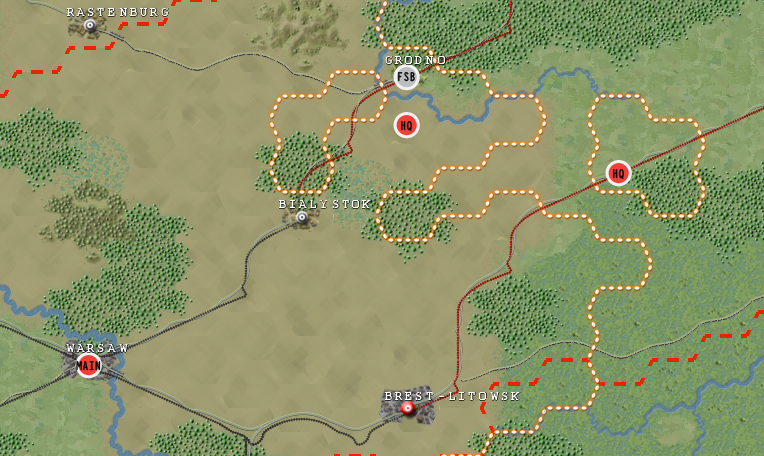
When Vic rolled his Panzergruppes eastward he was able to either punch through or bypass most of the Soviet Forces. Once clear he proceeded to capture many empty cities and towns. A number of these were classed as ‘Politically Important’ and their loss contributed to Stalin’s paranoid meltdown.
Vic made the good point that there should be, at the least, low level militia forces in all urban locations to prevent the Germans advancing at will.
The Soviets have the ability to play a ‘No Retreat’ Action Card which raises a large, well-equipped garrison in a Politically Important city that drew supplies from the city itself (eg. being cut-off wasn’t an issue for them).
I did this in Kiev and Odessa before the cost of doing so (the doubling…) put the option out of my reach. Odessa is still holding, surrounded by Romanians, but Kiev fell after a determined attack. This worked well (apart from the escalating cost) but it was too limited.
I’ve added a ‘Garrison’ card which, like a lot of other cards, can be played at no cost but only once a turn. It’ll add a low level Garrison unit to any city or town which, like the Fortification card, creates another mini-game. You can choose to put multiple garrisons in a single location or spread them thin to impede the Germans advance.
At one a turn you won’t be able to cover all threatened locations so the Germans will still be able to over run certain locations unopposed. Vic’s of the opinion that I need to auto generate them in all locations once the Germans approach within a certain distance but I’ve opted to give the Soviet Player control over the process at the cost of a smaller effect.
Yet another balancing item that awaits Beta testing – which will be in the New Year if you’re interested (email me at cameron.tasmania@gmail.com or place a comment below).
One other item worth mentioning before I bring this post to a long winded close, is feedback. Up until we started the test games the only person who had any prolonged exposure to the game was myself, the developer. This can lead, as you’d imagine, to tunnel vision.
The main manifestation of this was in the games ability to provide adequate feedback. This isn’t to say that it was absent, only that the game throws a lot of information at you and some of it wasn’t as obvious as it could be.
Vic struggled to get to grips with a few key mechanics and complained that the feedback wasn’t prominent enough. This is a fair comment and a lot of remedial work has since been put into improving this area.
Courtesy of some additional functionality provided by Vic there are now more visual clues as to what’s going on and the whole game is (or soon will be) sprinkled with detailed mouse-over tool tips. This has enabled a lot of streamlining and simplification of how information is displayed.

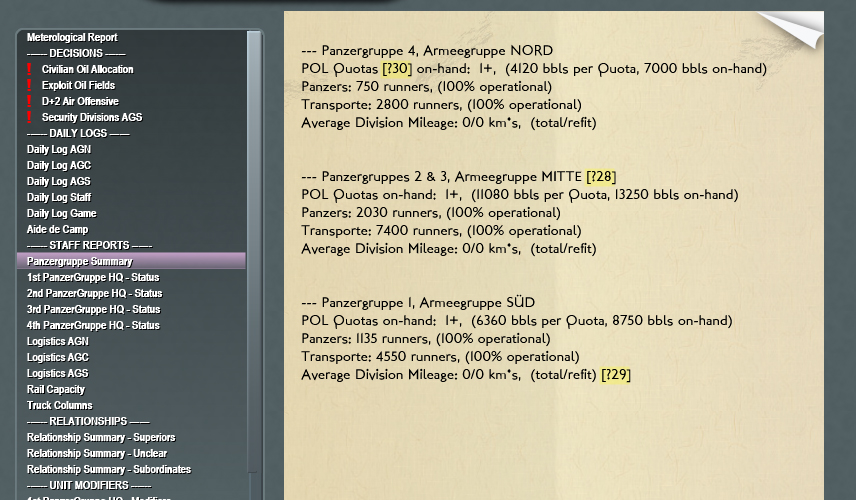
- The yellow areas indicate mouse-over areas which bring up detailed tool tips such as this one.
It’s an ongoing process with further improvements in the pipeline but it’s definitely heading in the right direction.
As is the rest.
Cheers and Festive wishes,
Cameron
 Loading ...